
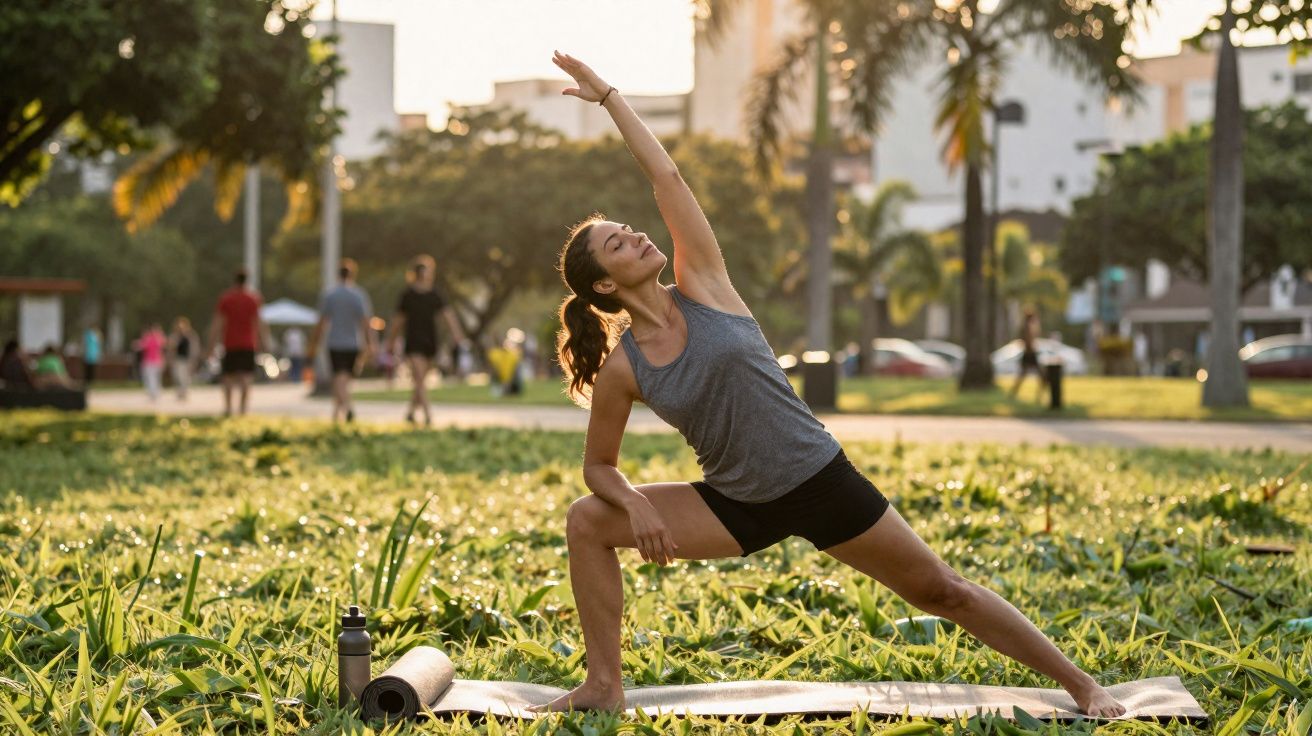
They complain in subtle ways - that first tight step off the kerb, the shoulder that won’t quite reach the top shelf, the neck that feels years ahead of the calendar. The morning arrives, the screens are already calling, and the day piles up quickly. What if the first ten minutes spent outside could change how your body moves for the next fourteen hours?
The park stirs before most workplaces do. Dog tags clink like tiny chimes, a man in a navy beanie drinks coffee from a mug with a chipped rim, and a robin carries on as if it has an audience. I roll my shoulders and sense the night’s stickiness begin to lift. The cool air meets my face and I can almost hear my knees exhale as I drop gently into a lunge by the bench. A runner passes on her loop, gives a small nod, and the dew deepens the colour of her trainers. Bodies tend to wake when the world does. Sunlight starts to warm the skin; the breath seems to come from lower down. Then, somewhere along the way, something eases.
Why morning outside changes how your joints move
Moving early switches on a system designed for smoothness. Your joints are coated with synovial fluid, and when you begin to move it behaves a little like honey that softens as it’s stirred. That easy motion helps press nourishment into cartilage - living tissue that does well with a steady pattern of load and release. Nothing needs to be forced. You’re simply giving it a chance.
Leah, 39, used to refer to her knees as “the hinges”. She began walking to the park five mornings a week and ran a short sequence beside the same maple tree. Three weeks in, she texted a friend, amazed she could squat to tie a shoelace without negotiating with her joints first. Large US surveys suggest roughly one in four adults lives with arthritis or ongoing joint symptoms, so her experience is far from unusual. A ten-minute spell outdoors can shift how your knees feel for the rest of the day. It isn’t magic; it’s your biology responding to a regular cue.
Sunlight and brisker air do their work quietly. Morning light helps anchor your body clock, which in turn influences hormones linked to inflammation and how you perceive pain. A light breeze on your skin rouses balance systems; slightly uneven ground prompts the small stabilising muscles around your ankles and hips to wake up too. Put together, you get improved blood flow, a clearer “map” of where your body is in space, and a joint environment that glides rather than catches.
An easy park routine: 10 minutes, zero equipment
Use a simple structure: 6–3–1. Six minutes to loosen and lubricate, three minutes to connect the chain, and one minute to breathe. Begin gently, explore different angles, and keep your breathing easy. If anything feels sharp or “spiky”, reduce the range. Your joints aren’t rusty hardware; they’re living tissue that adapts through kind, repeated practice.
Everyone knows the feeling of turning your head and it behaving like a stiff garden gate. The answer is usually less force, not more. Pair each reach with a soft exhale. Let your eyes lead your head, and let your fingers lead your arms. And honestly: no one does this perfectly every single day. Go for most days, forgive the rest. When a routine fits real life, small gains add up.
This is what a short session can look like out in the open. Choose a patch of grass, a tree, or a bench, and give your joints a friendly prompt - not a stern lecture.
“Motion is lotion,” says physical therapist Maya Ross. “Your cartilage doesn’t drink through a straw - it gets fed when you move, compress, and release. Do that kindly, and it will thank you.”
- Neck nods and turns, slow: 30 seconds. Let your eyes lead.
- Shoulder rolls into large arm circles: 60 seconds. Inhale as you lift, exhale as you circle.
- Standing cat–cow with hands on a bench: 60 seconds. Make it a wave through the spine, not a yank.
- Hip circles: 45 seconds each direction. Picture drawing smooth halos with your belt buckle.
- World’s Greatest Stretch, alternating sides: 2 minutes. Step forward, elbow to instep, twist up, switch.
- Walking hamstring sweeps: 60 seconds. Heel forward, hinge, sweep hands towards your shin.
- Ankle rocks by a tree: 45 seconds each leg. Bring knee towards toes without letting the heel lift.
- Calf stretch on a kerb or bench edge: 60 seconds, gentle hold, breathe low.
- Finish: 60 seconds of nasal breathing, eyes on the horizon. Notice your feet.
The why beneath the feel-good
Cartilage has no direct blood supply, so it depends on that squeeze-and-release from movement to draw in nutrients and flush out waste. Moving in the morning helps synovial fluid become more slippery, and it also activates mechanoreceptors - tiny sensors that tell your brain where your joints are. More useful information means less protective tension. Less tension makes movement easier.
Being outside turns the volume up on those effects. Light signals to your brain that the day has started, supporting steadier energy and a more stable mood. Grass, gravel, and mild slopes add micro-variation that treadmills and flat shoes often remove. Those little wobbles are valuable for ankles, knees, and hips. Stability isn’t built by going rigid; it’s built by learning to move well through lots of small challenges.
There’s a mental side to it as well. A bench becomes your studio, a tree your barre. You’re not hunting intensity; you’re building a habit. This works without perfection. What it needs is attention - and a bit of fresh air that reminds your body what it’s built to do.
You may leave the park a few minutes later than intended, socks slightly damp with dew, shoulders sitting a touch lower than when you arrived. The habit can spill into the rest of the day - taking the stairs instead of the lift, adding a short walk between calls, trying a curious stretch at a red light. The goal isn’t to collect flexibility like a trophy. It’s to keep your joints part of the day’s conversation so they don’t start shouting at night. Pass the routine on to a friend, turn it into a two-person ritual, and notice what shifts when “morning” starts to mean “moving”.
| Key point | Detail | Why it matters to you |
|---|---|---|
| Morning movement “lubricates” joints | Synovial fluid becomes less viscous and motion nourishes cartilage | Reduced stiffness through the rest of the day |
| Being outside adds useful challenge | Light, breeze and uneven ground activate balance and stabilisers | More control on everyday steps and stairs |
| Short and manageable works | The 6–3–1 approach fits into a 10-minute window | Easier to repeat and easier to notice progress |
FAQ:
- How hard should stretching feel in the morning? More like a courteous conversation than an argument. Aim for gentle tension that eases within 10–20 seconds as you breathe.
- Is static stretching or dynamic better right after waking? Begin with dynamic movement to warm and lubricate, then add brief static holds for calves, hips and chest once you feel warmer.
- What if my knees click on lunges? Clicking without pain is common. Reduce the range, slow it down, keep the knee lined up with the middle toes, and try a bench-supported version.
- Can I replace coffee with this routine? You don’t need to pick one. This routine goes well with coffee, and the light exposure supports your natural wake-up chemistry.
- How many days a week make a difference? For most people, three to five sessions makes a noticeable difference. Even two days can create momentum you can build on.

Comments
No comments yet. Be the first to comment!
Leave a Comment