
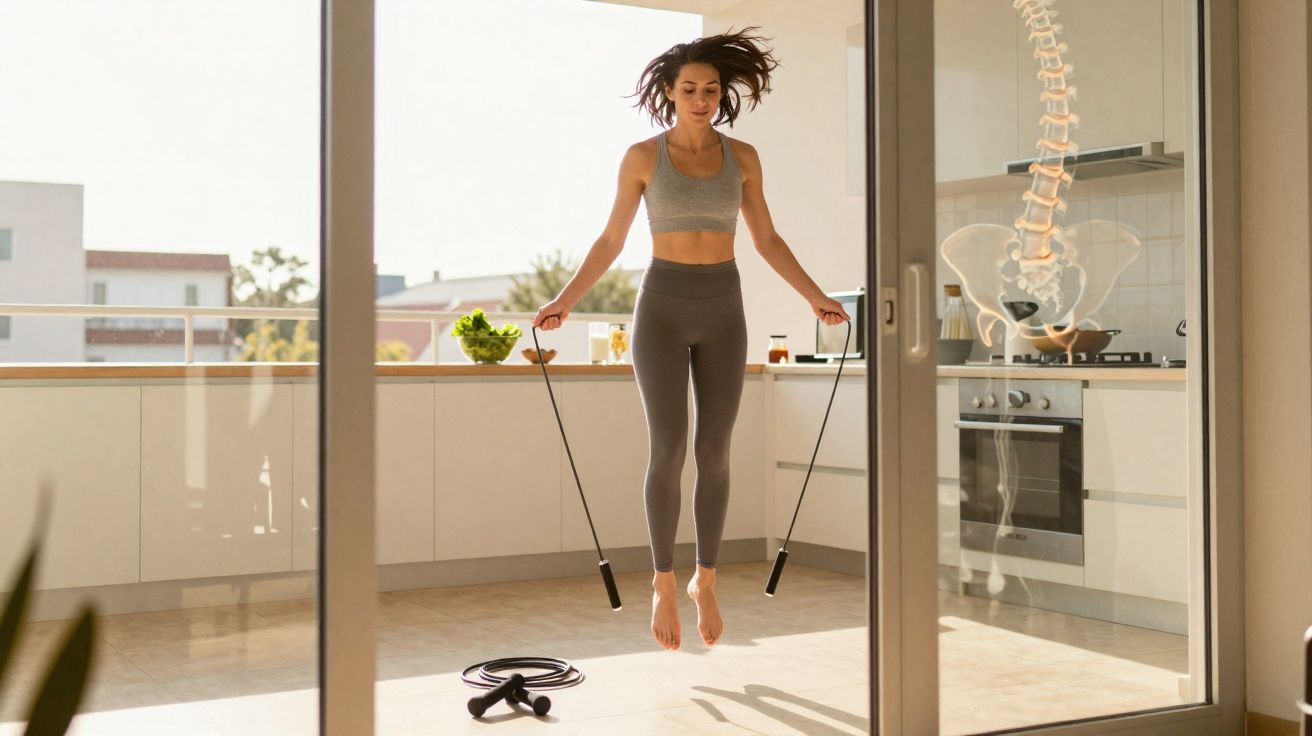
The physio had a routine. Long before she asked what was sore, she’d clock how you moved as you came into her cramped, stifling room. That afternoon, a 29-year-old graphic designer edged in with a shuffle: immaculate trainers, upright posture, and a Fitbit proudly blinking 8,000 steps. “I don’t run,” she said at once. “I do Pilates. I don’t like impact.”
The physio gave a small nod and then dropped a question with the weight of a brick: “When was the last time you actually jumped?”
The woman laughed - and then stopped. Was it in childhood? School netball? A tipsy dance at a wedding? The pause hung there. Her scans lay on the desk: the early signs of bone density loss around the hips. Nothing extreme. Nothing headline-worthy. Just the quiet start of something that shouldn’t really be showing up at 29.
The physio pointed at the image with her pen and said, almost offhand: “Bones know when you stop challenging them.”
That sentence stuck. Because around that age, your skeleton starts taking notes.
The silent moment your bones start slipping
We’ll happily talk about wrinkles, metabolism, and “feeling old at 30”, yet bones rarely get a mention. They ought to. Bone is living tissue, always remodelling itself based on what you demand of it. If you never jump, never sprint, never hit the ground with a real thud, your body adjusts - quietly - by maintaining less.
By the time you’re in your late twenties, and often right around 29, that shift matters more. Peak bone mass is largely behind you. From here on, you’re primarily trying to hold on to what you’ve built. And when life is made up of soft sofas, even pavements, and strictly low-impact workouts, your skeleton starts cutting costs.
Imagine a standard city day. Lift up to work. A wheeled chair at your laptop. Coffee breaks propped against the counter. Travel home, a quick YouTube yoga flow, then bed. No sprinting for a bus. No playing tag with children in the park. Absolutely no spontaneous star jumps in the kitchen. That’s 24 hours where gravity’s message to your bones is reduced to little more than “background”.
Do that for months, then years, and the signal is unmistakable: “We’re not being slammed, rattled or jolted any more. We can afford to be weaker.” That’s how a 29-year-old can end up with bones acting more like someone in their mid-thirties.
The biology is blunt. Bone density increases when bone is loaded quickly and decisively - jumps, hops, sprints, even stamping. Gentle pressure applied slowly doesn’t create the same stimulus. Walking is brilliant for plenty of things, but it isn’t the same as leaving the ground and landing again.
When you stop jumping altogether, the skeleton drifts into a sort of maintenance-lite. Osteoblasts - the cells that build bone - get fewer prompts to get to work. Osteoclasts - the cells that break bone down - keep doing what they do. Over time, the balance shifts the wrong way. For many people, that slide begins around 29, just as “impact” starts to feel like something you’ve outgrown. The timing is appalling.
How to “re-teach” your bones impact without wrecking your joints
Here’s the reassuringly unglamorous bit: even small, slightly awkward attempts can still nudge your bones to respond. You don’t have to become a CrossFit devotee, and you definitely don’t need to start launching yourself onto boxes in your lounge. Begin with what physios often call “micro-impact”. That might be 10 gentle heel drops off a step, twice a day. Or 30 seconds of small, low bunny hops on a soft mat.
The key is repetition, not theatrics. One brutal HIIT session won’t rewrite your bone density trajectory at 29. A few minutes of modest, regular jumping scattered across the week just might. Bones respond to patterns, not grand gestures.
If “jumping” instantly makes you think of wrecked knees and rolled ankles, you’re in good company. Some days, standing up from the sofa feels like an event in itself. So you start with your real baseline, not the one social media sells. Bare feet on a rug. Tiny, almost comical hops: knees soft, shoulders loose, body relaxed.
Let’s be honest: hardly anyone does this daily. And that’s fine. The goal isn’t faultless consistency; it’s gently shifting your routine so impact stops being a rare, alarming surprise and becomes something your body remembers.
One sports doctor I spoke to explained it like this:
“Your bones are like a bank account. If you’re under 30 and never jumping, you’re underpaying into the pension you’ll need at 60.”
To make it practical, use simple anchors you’ll actually remember:
- Every time the kettle boils: 15 gentle hops on the spot.
- Before your shower: 10 heel drops off the edge of the bathmat.
- Twice a week: 5 minutes of skipping with a rope - or miming it if you prefer.
None of it is particularly shareable. But this kind of dull, invisible practice can quietly change what your future scans look like.
The emotional weight of “starting to lose density at 29”
There’s a distinctive hush when someone under 30 hears “early bone loss”. It doesn’t feel dramatic enough to qualify as a crisis, but it tugs at everything nearby: ageing, possible future pregnancies, the memory of a parent’s hip replacement. On the surface, life carries on exactly as before. Underneath, the scaffolding of your body has started a long, slow negotiation with gravity.
And that’s where it really hits - not in the data, but in the way you suddenly notice every staircase, every time you didn’t run, every class you half-arsed and then skipped.
One night on a late bus, I watched a group of friends in their late twenties arguing about whether they were “too old” for trampoline parks. Someone joked about “snapping a hip mid-backflip” and they all laughed. Then they didn’t go. That’s the real-life pattern: jokes, then avoidance, then habits, then scans.
Most of us have had that moment when we realise it’s been months since we did anything purely for physical joy. No targets, no calorie maths - just the childish thrill of hanging off something, landing badly, and having another go. When you lose those messy, playful impacts, you also lose a quiet kind of strength - the sort you don’t miss until much later.
Bone density loss at 29 isn’t a blaring alarm. It’s a whisper. Your skeleton doesn’t punish you overnight; it gives you years of second chances. That’s the strange mercy of it. You can put off jumping until your early thirties and still turn things around significantly. You can begin with bodyweight strength training, add a bit of jogging, test out dance classes that get you off the ground.
What matters is not deciding you’re “fragile” or “too old” the moment someone mentions osteopenia. The story you tell yourself about your body at 29 shapes what you’ll dare to try at 39 - and that, quietly, shapes your bones.
| Key point | Detail | Why it matters to you |
|---|---|---|
| Peak bone age | Bone mass peaks in the late 20s; by 29 you’re mostly in “maintenance” mode | Helps you understand why today’s habits affect your risk of fractures later |
| Impact matters | Jumping, hopping and fast loading build more density than slow, gentle movement alone | Gives you a concrete reason to add short bursts of impact to your week |
| Small changes work | Micro-sessions of impact (2–5 minutes) done regularly can shift bone health over time | Makes the idea feel doable, rather than yet another massive fitness overhaul |
FAQ:
- Is 29 really “too late” to build stronger bones? Not at all. You may be past the peak bone-building window, but you can still slow bone loss dramatically and even gain density with impact, strength training, and enough calcium and vitamin D.
- Do I have to do high-impact HIIT workouts? No. Low, controlled jumps, skipping, brisk stair climbs, and strength work all help. HIIT is one option, not a requirement.
- What if I already have knee pain? Begin with strength and balance work, then introduce tiny, supported impacts with professional guidance. Soft landings and good form matter more than height.
- Can walking alone protect my bones? Walking supports many aspects of health, but it’s usually not enough by itself for optimal bone density in the hips and spine. Adding short impact bursts can make a real difference.
- How often should I jump for bone health? Research often points towards most days of the week in small doses: think 30–50 hops or a few minutes of skipping, spread across the day, rather than one huge weekly effort.


Comments
No comments yet. Be the first to comment!
Leave a Comment