
A new, slow-moving but brutally intense method is promising a turning point right where many people get stuck.
Plenty of people begin Pilates and rave about improved posture and fewer back aches - until progress suddenly stalls. Your muscles adapt, the movements start to feel “nice”, but no longer demanding. If you want more definition, it’s common to jump straight into punishing HIIT or CrossFit, only to pick up knee or back niggles. Lagree Fitness sits right in that gap: training that hits hard, yet feels surprisingly kind on your joints.
When classic Pilates is no longer enough
At first, Pilates can be transformative: you stand taller, you breathe more consciously, and tightness eases. After a few months, though, many notice that visually, very little continues to change.
"Without increasing intensity, the body stops adapting - and visible change stops with it."
From a physiological standpoint, that’s straightforward. Your body is built for efficiency. Once it can handle a given load, it uses less energy to perform it, burns fewer calories, and has little reason to build additional muscle. Moves that used to feel tough can start to resemble a warm-up.
Why your body slides into a plateau
With mat-based Pilates, two ingredients are usually missing:
- variable resistance you can genuinely feel
- a long period under constant muscular tension
That means the deeper muscle fibres responsible for crisp contours and firm lines are only activated to a limited extent. The result: posture stays good, but your stomach, glutes, arms and shoulders often stop changing in appearance. Frustration is almost guaranteed.
Why many people fall into the HIIT trap
Looking for “more”, many end up with high-intensity intervals, sprints, jumps, or CrossFit-style workouts. Your heart rate rockets, no doubt. The price, however, is often paid by tendons, joints - and frequently the pelvic floor.
If you’re no longer in your early 20s, or you already have minor aches, you quickly discover that this level of impact is hard to sustain healthily. That’s where Lagree Fitness becomes interesting, because it claims the best of both worlds: high intensity without jumping, delivered with the controlled precision people associate with Pilates.
Lagree Fitness: not “Pilates on steroids”, but a system in its own right
Lagree Fitness originated in California and, in Europe, is mostly offered in specialist studios. At a glance, the space can look like a sleek Pilates studio - but a few minutes on the machine makes it obvious you’re playing in a different league.
The idea is simple: maximum intensity with minimal impact. You work the muscles to true muscular failure - the point where another clean repetition just isn’t possible. At the same time, joints, ligaments and the spine are protected because there are no jumps and no hard landings.
The Megaformer: the heart of the workout
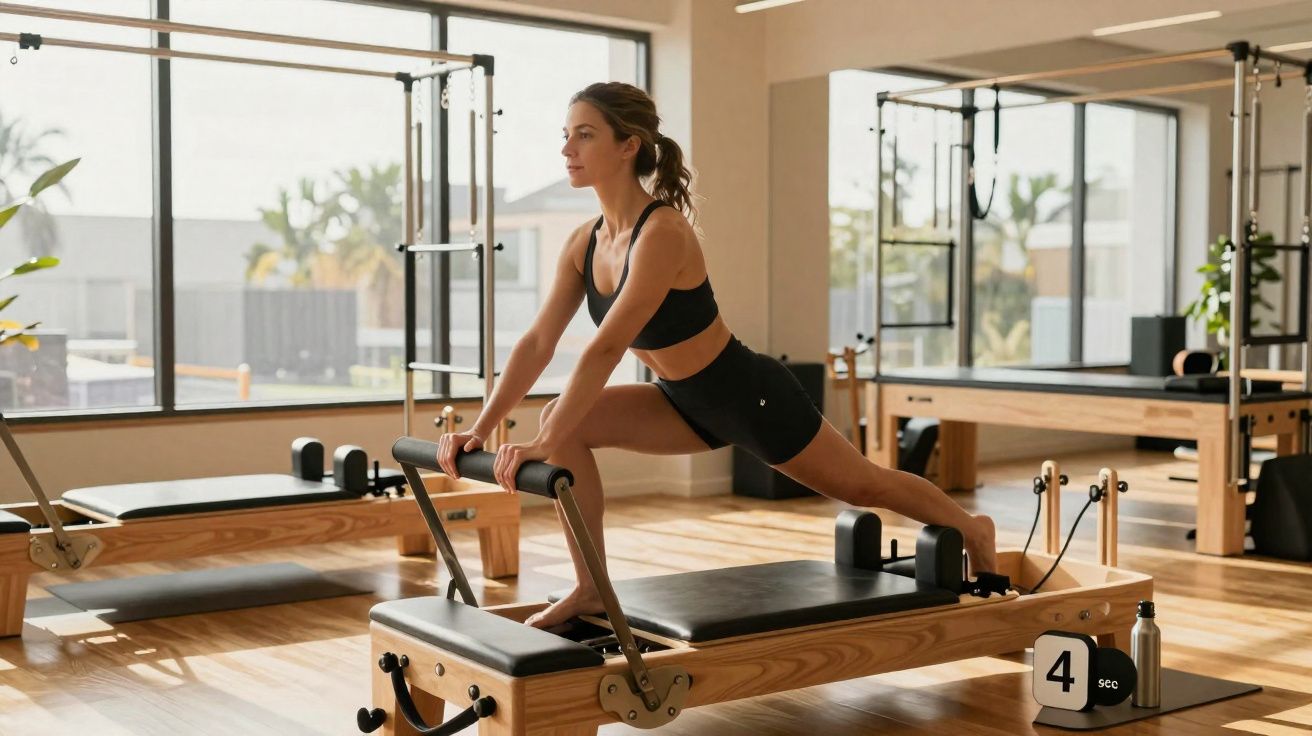
At the centre of everything is a large machine: the Megaformer. It resembles the familiar Pilates Reformer, but it’s heavier-duty, more complex, and built for continuous loading.
Typical Megaformer features include:
- a moving carriage in the middle
- two platforms at either end for different standing and support positions
- fixed and adjustable handles
- springs with different tension levels to provide resistance
Unlike the classic Reformer - often used in rehabilitation - the Megaformer isn’t designed to make movement comfortable. It supplies steady resistance in every direction. Breaks only happen if the person training chooses to take them.
A full-body workout in one run-through
Lagree blends strength work, endurance and core training into a single session. Many movements are multi-joint. For example: you perform a lunge variation on the unstable carriage, keep your trunk braced at the same time, and also pull on cables to challenge arms and shoulders.
"Your pulse doesn’t rise because you’re sprinting, but because large muscle chains work at the same time and need huge amounts of oxygen."
That creates a hybrid of strength training and “hidden” cardio. Your heart works flat out - without a single jump.
The magic of slowness: why tempo shapes your body
The most unexpected part of Lagree may be this: it’s not about how many reps you can cram into 30 seconds, but how slowly you can execute them without collapsing.
Four seconds that change everything
The foundational rule is that each phase of the movement lasts at least four seconds - four seconds into the stretch, four seconds back. No momentum, no bouncing, no “shortcuts”.
If you take that seriously, you’ll quickly notice how one perfect rep can feel like a full set in a traditional gym.
"Slow movements remove momentum from the exercise and force every muscle fibre to do real work."
This controlled pace targets the slow-twitch fibres linked to a lean, defined look, while also improving overall muscular endurance.
Continuous tension instead of rest between reps
Unlike conventional strength training, there’s rarely a famous “relaxation moment” at the top or bottom of the movement. The muscles remain under tension the entire time - often for 60 to 120 seconds without a true stop.
That prolonged stress leads to:
- intense burning in the muscle
- a powerful stimulus for muscle building and fat reduction
- a noticeably higher afterburn effect after training
People new to it are often shocked that such a quiet, almost meditative tempo can “cook” the body so thoroughly.
How the Megaformer activates muscles you didn’t know you had
Even experienced exercisers often get a small shock on the Megaformer: deep muscles around the spine, hips and shoulders suddenly make themselves known - muscles that barely registered in the gym or while running.
Instability as the trick for a flat, strong stomach
The moving carriage always stays slightly wobbly. To avoid sliding off, your body has to keep your core switched on continuously. That’s not just the “six-pack” muscle, but especially the deep abdominals, the waist, and the small stabilisers along the spine.
"Instead of doing hundreds of crunches, you keep your body stable - and that challenges your stomach far more intensely."
This tends to create a flatter, firmer middle rather than a “pumped” abdomen. Many people report a steadier lower back, a narrower-looking waist, and posture that feels more direct and confident.
Fast transitions keep your heart rate elevated
The reps themselves are slow. Between exercises, the opposite applies: within seconds you switch from a leg move to one for arms or core. Long water breaks are uncommon.
That keeps your heart rate in a zone where the body burns fat efficiently without completely draining you. You sweat heavily, but it feels more like a highly focused strength session than chaotic interval training.
The famous shaking: why your muscles have to wobble
In Lagree studios, you’ll quickly hear one word: “Shake”. It refers to the visible trembling that appears towards the end of an exercise block.
When the muscle shakes, change begins
That trembling happens when muscles and the nervous system hit their current limit. The body fights to maintain tension and recruits more and more fibres.
"The shake isn’t an alarm - it’s a signal: this is the exact moment your muscles strengthen and adapt."
If you accept the wobble instead of stopping, you train your mindset as well as your body. Stamina, focus, and trust in your own capability grow noticeably.
High intensity, minimal stress on joints
Despite the intensity, your hands and feet are almost always in contact with the machine. There’s no impact like running, no jump sequences out of a squat, and no abrupt direction changes on hard floors.
That makes Lagree particularly suitable for people who:
- want to protect their knees, hips and ankles long term
- already feel minor joint issues
- want to return after pregnancy or a long break from exercise (once cleared by a doctor)
Surrounding muscles become stronger, while cartilage is protected from unnecessary wear.
Leaner, more defined, not wiped out: what fascinates many people about Lagree
Lagree relies on long tension phases and lengthening under load. The goal isn’t bulky muscle gain, but a taut, athletic physique with clear lines.
Results that can become visible after a few weeks
With two to three sessions per week, many studios report similar effects:
- noticeably improved everyday posture
- faster-visible definition in shoulders, arms and legs
- a firmer-feeling midsection
- less urge to do “extra” ab work
Many compare the silhouette to that of a dancer or Pilates professionals - just with stronger contours and a bit more functional strength for daily life and sport.
Why many people don’t want to go back after the first class
Once you’ve felt how efficient a 45-minute Megaformer session can be, traditional machine circuits or long steady cardio can start to feel sluggish and unfocused. After one session, legs, glutes, stomach, back and arms feel properly worked - without leaving you completely empty.
Many leave the class with shaking muscles, yet a surprisingly clear head and a light, alert feeling in the body. That combination of intense effect and preserved energy is exactly what turns Lagree into a favourite routine for so many.
What beginners should know and who the method is for
Lagree is demanding, but studios typically teach in small groups with close coaching. Beginners start with lighter spring tensions and learn proper form first. If you already have Pilates experience, you’ll usually find your feet quickly - even though the intensity is clearly higher.
A few practical tips for getting started:
- don’t schedule too many sessions back-to-back at first - muscle soreness is practically guaranteed
- keep the tempo and range of motion slightly smaller until you have full control
- focus on steady breathing rather than holding your breath
- speak up if something hurts in a joint rather than in the muscle
If you sensibly combine the training with walks, moderate cardio, or gentle yoga, you’ll also support recovery and mobility. The result is a sustainable mix: a stronger, more defined body, healthier joints, and enough energy for work, family and leisure.

Comments
No comments yet. Be the first to comment!
Leave a Comment