
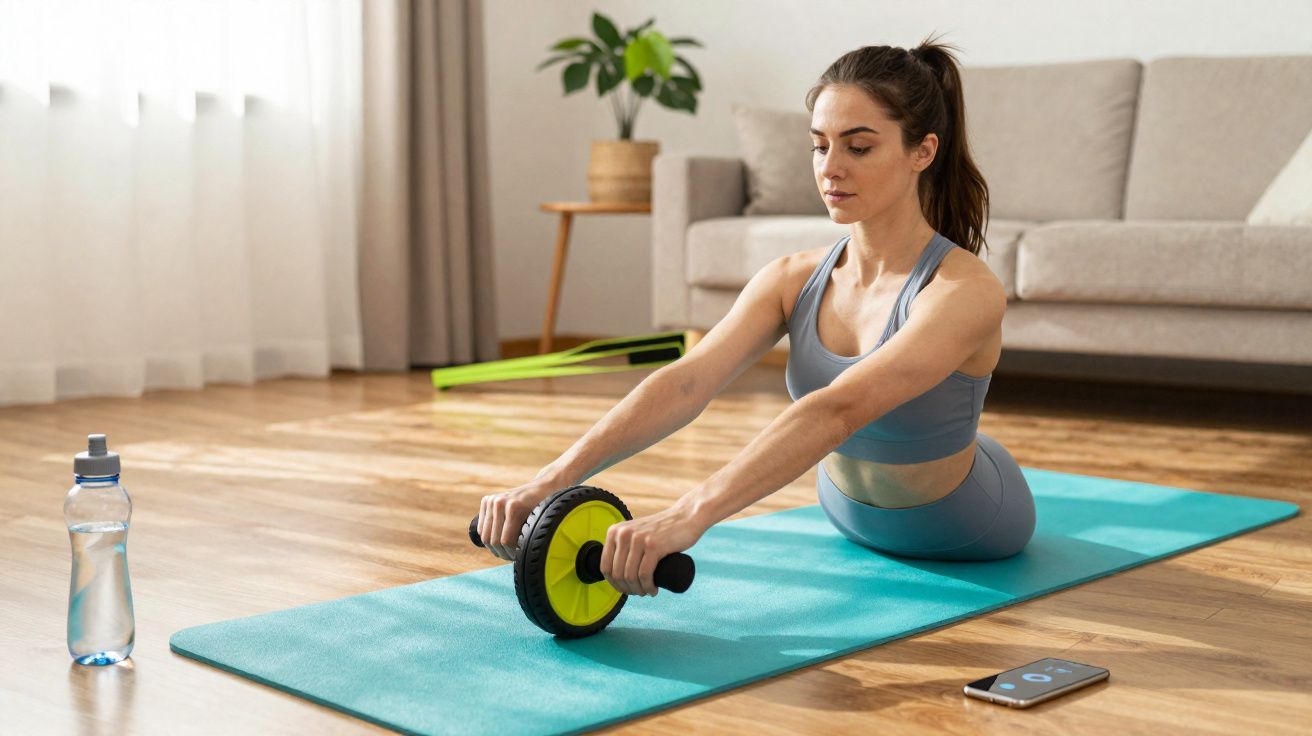
Building a stronger trunk makes you feel steadier, helps you stand taller, and makes everyday strain easier to tolerate. A small piece of kit can make a surprising difference here. When it comes to abs, results come down to the right technique, consistent practice, and a sensible plan. One specific feature, in particular, can noticeably boost confidence and speed up progress.
A 2-in-1 device for your abs
Decathlon sells an ab wheel with optional pull-back assistance via an elastic band. The idea blends two familiar tools: an ab wheel plus a resistance band. In practice, that means focused core work with a more controlled rollout, all in a compact at-home setup.
"Value for money in focus: the ab wheel with guided elastic band costs €16.99 and combines rollout training with support for more control."
How the system works
During the forward-and-back motion, the wheel challenges your entire midsection. The band acts like a return aid and takes the edge off at the hardest point of the rollout. That makes it easier for beginners to avoid collapsing or tipping forward uncontrollably. More experienced users can simply remove the band and increase range, speed, or repetitions.
"With the band you train more cleanly and for longer; without the band it’s more intense and freer - one setup for several performance levels."
Who it’s worth buying for
- Beginners who want to build stability and avoid excessive lower-back arching.
- Intermediate/advanced trainees who want a tool that allows progressive increases in difficulty.
- Anyone short on space, because the wheel fits easily into a drawer.
- Outdoor fans who want to slot in short, tough core sessions almost anywhere.
If you’ve dealt with back issues before, begin on your knees and keep the range of motion small. If symptoms are new, severe, or you’re returning after surgery, get medical clearance first.
The belly fat myth - what actually works
Training one specific area doesn’t remove fat exactly there. What the wheel does do is build muscle and raise the calories you burn per session. Visible change comes from two levers working together: a calorie deficit through diet and regular activity across the week. Combined, these reduce waist measurement far more reliably than doing crunches alone.
| Day | Focus | Sets/Reps | Note |
|---|---|---|---|
| Monday | Ab wheel with band (on knees) | 4 x 8–12 | Roll out slowly and keep tension |
| Tuesday | Walking or cycling (30–40 min) | - | Easy effort, conversational pace |
| Wednesday | Ab wheel without band | 5 x 6–10 | Short range, quality over quantity |
| Thursday | Full-body bodyweight session | 20–30 min | Squats, press-ups, planks |
| Friday | Interval cardio (e.g. 10 x 45/15 s) | 10–15 min | Plan a warm-up and an easy cool-down |
| Weekend | Walk + mobility | 30–60 min | Mobilise hip flexors and thoracic spine |
Technique: how to roll out safely
- Kneel on a mat, take the handles, and position your shoulders over the wheel axle.
- Brace your abs, lightly tense your glutes, and draw your ribs down.
- Roll forward slowly, extending your arms without dropping into an arched lower back.
- Pause briefly at the furthest point you can control, then pull back smoothly.
- Control your breathing: exhale as you roll out, inhale as you return.
"Keep a long body line and a neutral lumbar spine. Stop as soon as you can’t maintain core tension."
Progression in small steps
- Start: use the band, keep the rollout short, train 2–3 times per week.
- Build up: increase the distance and slow the eccentric (take 3–4 seconds to roll out).
- Switch: remove the band, add sets, or work towards rollouts from the toes.
- Vary: add angled rollouts to the right/left to target the side chain.
Purchase arguments from real-world use
At €16.99, the price makes getting started much easier. It takes up very little room, needs no maintenance, and works on almost any firm surface. The guided assistance helps you begin with better control and reduces frustration from reps failing early. If you already have a stable core, the same tool can still deliver a very dense training stimulus across the entire anterior chain, including the lats and hip flexors.
Common mistakes and fixes
- Over-arching at the deepest point: shorten the range, brace first, and use the band.
- Shoulders creeping up: actively guide your shoulder blades forward and down.
- Moving too fast: stick to three seconds out and two seconds back.
- Letting only the arms do the work: pull ribs down, slightly tuck the pelvis, keep the abs switched on.
- Training too infrequently: block out fixed slots, for example Mon/Wed/Fri.
"More quality per repetition delivers more visible change in four weeks than twice as many sloppy rounds."
How to combine the ab wheel with everyday life
Use short micro-sessions. Do two rounds after getting up and two rounds in the evening. Each session takes under five minutes. Over the week, that adds up to a training volume that genuinely pays off. Alongside this, a small calorie deficit of 200–300 kcal per day reliably reduces body fat percentage.
Core, explained briefly
The core isn’t just the rectus abdominis. It also includes the obliques, deep transverse muscles, spinal erectors, glutes, and parts of the latissimus. The ab wheel hits this chain at the same time, which improves force transfer, posture, and resilience during everyday movements such as lifting, carrying, or twisting.
10-minute sample routine
- 2 min mobility: cat-cow, shoulder circles, hip openers.
- 6 min EMOM (every minute on the minute): 6–10 rollouts, rest for the remainder of the minute.
- 2 min finisher: 3 x 20–30 s forearm plank, 20 s rest.
If you still need help, use the band every second minute during the first few weeks. That keeps technique tidy, lifts your heart rate, and helps motivation stay high.
Notes on risk and dosing
If you have acute back or shoulder problems, don’t do rollouts without professional clearance. Pain is a stop signal. Keep it challenging but not painful. Make sure the surface doesn’t slip and use a knee-friendly pad. Two to four sessions per week are enough, as long as repetitions remain clean.

Comments
No comments yet. Be the first to comment!
Leave a Comment