
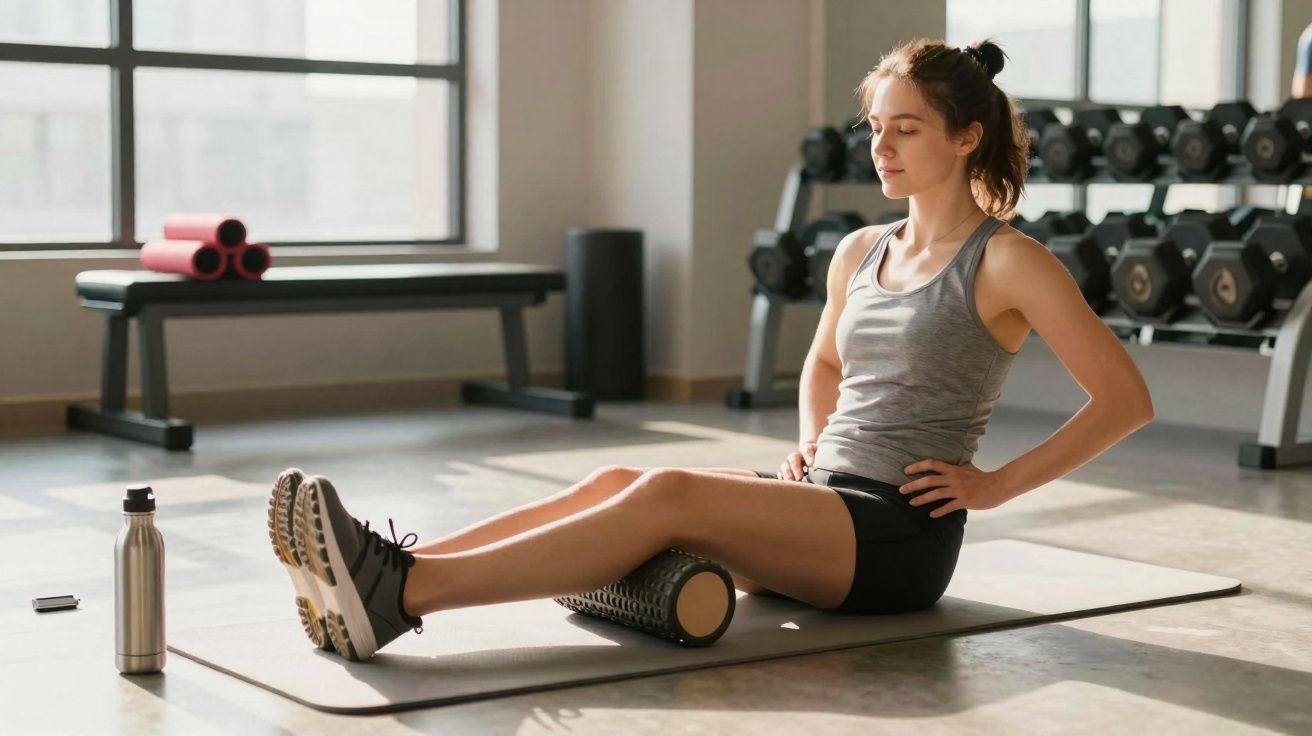
Someone stays down on the mat beside you, props themselves up on a foam roller and starts slowly rolling out their thighs. You glance over, feel the tightness in your own muscles - and still head straight for the changing rooms. Another ten minutes… for what, exactly?
On the way home, there’s that tug in your calf. The next morning brings the classic “stairs are my enemy” phase. We all know that moment when you wonder whether you skipped a small but crucial part of your session. The bit that isn’t sexy, doesn’t give you a visible pump, but decides the long game. The bit almost every trainer recommends - and hardly anyone truly takes seriously.
That’s where the real story of your training actually begins.
What really happens in your body after the last set
Once you rack the weight, you look calm from the outside. Inside, though, things are still buzzing. Your heart rate is elevated, metabolic by-products such as lactate are still moving through the tissue, and your muscles hold on to residual tension. Your nervous system is still shouting “we’re working!”, even though you’ve already reached for your water bottle. That short window after you finish surprisingly often determines how you feel the next day.
Trainers can sound like the fun police when they say, “Five more minutes - roll out or stretch.” In reality, they’re trying to steer that internal afterburn phase. This is exactly the moment you can nudge your body from “fight mode” into recovery mode. If you stop abruptly, you essentially leave your system mid-race. It works - for a while. Until, at some point, it doesn’t.
Picture a standard after-work scene at the gym: 18:45, packed floor, everyone in a rush. A young bloke smashes out squats, leg press, lunges. Strong session, loads of drive. When he’s done, he checks his phone, wipes his face with his towel - and disappears. Not even two minutes of cooldown. No rolling, no stretching, nothing. Two days later he’s limping slightly, his knee feels “odd”, and his lower back is niggling. Happens, people think. Comes with the territory.
The trainer who watched him recognises a pattern she sees almost daily. She talks about members who graft for months, pushing harder and harder, yet completely switch off when it comes to post-session care. Then, out of nowhere, an irritated Achilles tendon, shoulder trouble, stubborn tightness in the neck. Not from one single “wrong” day of training, but from the accumulated tension that never really gets defused. To her, those five to ten minutes after training are like a seatbelt: you only realise how valuable it is when something goes wrong.
On a purely physical level, the reasons are fairly straightforward. Under load, muscle fibres repeatedly shorten, fascia subtly tightens, and the nervous system fires at a high frequency. If you spend a short time at the end rolling out or gently stretching, you give your body a different message: “The danger’s over - you can let go.” That switch gives the parasympathetic system - your “rest and digest” mode - more space. Blood flow and lymphatic circulation pick up more effectively, metabolic waste is cleared faster, and the muscles get more oxygen.
Let’s be honest: hardly anyone manages it every single day. Even so, five intentional minutes after training can change your tissue tone. Passive tension drops, and minor adhesions in the fascial network get “brushed out” regularly instead of building over weeks. You won’t see that in the mirror tonight - you’ll notice it in your mobility in six months. If you roll out or stretch consistently, you’re not only preventing pain; you’re also raising your personal workload ceiling - with far less drama in day-to-day life.
How to roll out or stretch properly in 5–10 minutes
A short post-work block doesn’t need to be a wellness ritual with scented candles. It can be technical, simple and efficient. Set a timer for five or eight minutes before you even start your last set. Then choose three to four areas you worked hard: after leg day, for example, the front of the thighs, glutes and calves; after upper-body sessions, more like chest, lats and neck. Give each zone 30–60 seconds, either with the roller or with calm stretching - no yanking, no bouncing.
When you use the roller, move slowly - almost bored on purpose. You’re not hunting maximum pain; you’re looking for spots that “talk back”. When you find one, pause briefly and breathe deeply and deliberately. With stretching, follow the same rule: go only as far as you can feel clear tension while still breathing comfortably. A gentle pull that eases a little after a few breaths is your sign the tissue is releasing. That’s all it takes to open the door to recovery.
A common mistake is trying to fix everything in those few minutes - years of problems in one go. That’s when people attempt extreme stretches, glorify pain (“No pain, no gain”), or quit altogether because it “doesn’t do anything anyway”. The real value is the habit, not the intensity. If you pick just one or two small areas after each workout, you’ll stay mentally engaged. Over time, your brain automatically links the end of training to a brief “maintenance sequence”.
Another classic: rolling suddenly replaces everything else. No warm-up, no attention to technique - but ten minutes on the roller. That’s like brushing your teeth after four energy drinks: it helps a bit, but it doesn’t address the real issue. Treat rolling and stretching as one building block, not a miracle cure. And yes, there will be days when you can’t be bothered, you’re exhausted, and every mat is taken. On those days, two minutes is still enough. Consistently small beats heroically not at all.
“I always tell my clients: your training doesn’t end with the last rep. It ends when you briefly reach out a hand to your body and say: thank you - you can power down now.” – Personal Trainer Lena, 34
A simple mental checklist can help with your own mini cooldown:
- Pick one area that feels especially “full” or tight today
- Set a timer instead of rolling or stretching for a vague “quick minute”
- 30–60 seconds per muscle group, slowly, with calm breathing
- No jerky movements, no chasing pain - just clear, noticeable tension
- Finish with three deep breaths standing or lying down to settle the system
Why these last minutes often make the difference
The most unglamorous part of training is often the deciding factor in whether you stick with it long term or eventually quit out of frustration. If you’re regularly walking around with sore knees, tight hips or a stiff neck, you start associating exercise - subconsciously - with “ouch” and hassle. Those short post-session minutes act like a small insurance policy against exactly that. They don’t pay off in a day; they pay off over years.
There’s something deeper here too: the feeling you finish your session with. When you give yourself a few breaths on the mat after your last rep - a roller under your back, a gentle hip stretch - you’re sending yourself a signal of respect. Not only for what you achieved, but for the body that carries you through your daily life, not just through dumbbells. Over time, that mindset shapes how you handle stress, sleep and nutrition - even if you never consciously plan it.
Maybe that’s the quiet reason experienced trainers keep banging on about this. They’ve seen how many ambitious people give up after a year of constant little niggles. And they notice the few who take the time to roll out or stretch - quietly, without any big Instagram fuss - and who are still there years later: stronger, more mobile, more relaxed. In the end, it’s not about whether you recover “perfectly”. The real question is: after training, do you give yourself those few minutes to listen to your body, rather than only using it?
| Key point | Detail | Benefit for the reader |
|---|---|---|
| Short rolling/stretching after training | 5–10 minutes of targeted work on the muscle groups you’ve loaded | Less muscle stiffness, better recovery, lower injury risk |
| Gentle intensity instead of chasing pain | Slow movements, steady breathing, no extreme pulling | More relaxation, better body awareness, reduced risk of overload |
| A consistent mini habit | A brief cooldown after every session, even if it’s only a few minutes | More mobile, more stable and more stress-resistant in everyday life over the long term |
FAQ:
- How long should I roll out or stretch after training? For most people, 5–10 minutes is enough, split across 3–4 muscle groups you challenged most in that session.
- What’s better: stretching or a foam roller? Both have a place: the roller tends to target connective tissue more, while static stretching focuses more on muscle length - a short combination block works best for many.
- Can rolling or stretching cause muscle soreness? Yes, if you go extremely hard or overload sensitive spots, so start moderately and increase intensity gradually.
- Does stretching after training really help with DOMS? It can reduce the feeling of stiffness and support circulation, but it generally won’t prevent DOMS completely.
- Is it enough to roll out or stretch only on training days? For many, that’s a solid start, and on particularly stressful or sedentary days a short session without training can also be very calming.





Comments
No comments yet. Be the first to comment!
Leave a Comment