
It began on a Tuesday with that familiar London mix of damp air and the sharp tang of bus brakes.
I pushed open the door to the community gym by the overground, feeling a bit battered from acting as though a “100 sit-ups a day” challenge was a personality trait. Inside, it was the usual soundtrack: trainers squealing, chart-pop remixes, and someone’s bottle knocking against a mat. My lower back grumbled while my phone served up yet another “core blast” reel I was never going to finish. Then a coach-warm-eyed, with a smile that was just a touch mischievous-hovered a thumb over a stopwatch and said, “Three minutes. No crunches.” I didn’t buy it. I assumed he’d park me in a plank and keep me there until my elbows filed a formal complaint. He didn’t. Instead, he taught me something quieter, stricter, stranger-and suddenly the floor felt like it had feedback. I haven’t thought about my stomach the same way since, and there’s a decent chance you won’t either.
The day I stopped counting and started holding
Sit-ups have a knack for feeling productive because they look busy. Knees up, steady puffing, and that little squeak as your spine taps the mat again and again. You leave sweating and faintly triumphant, as if you’ve negotiated gravity down. It’s compelling-right up until your hip flexors crash the party and your neck starts drafting an apology request. That Tuesday, it clicked: I’d been practising effort that made noise, not strength that carried over.
Most of us know the moment when a go-to exercise turns into a bargain with discomfort. I kept insisting it was “just the burn”, but the soreness had wandered somewhere it didn’t belong. The coach clocked me stretching my lower back the way commuters stretch a ticket at the barrier. He slid a mat my way and said, “Try something different. Less drama, more signal.” It landed like a challenge I couldn’t wriggle out of.
On the rubber flooring, I caught the faint citrus of disinfectant and the dusty metal smell from the dumbbell area. I braced for a plank endurance test. He went another route. “You’ll shake,” he warned. “That means it’s working.” Exactly the kind of promise I trust: candid and mildly alarming.
Meet the quiet killer: the hardstyle plank
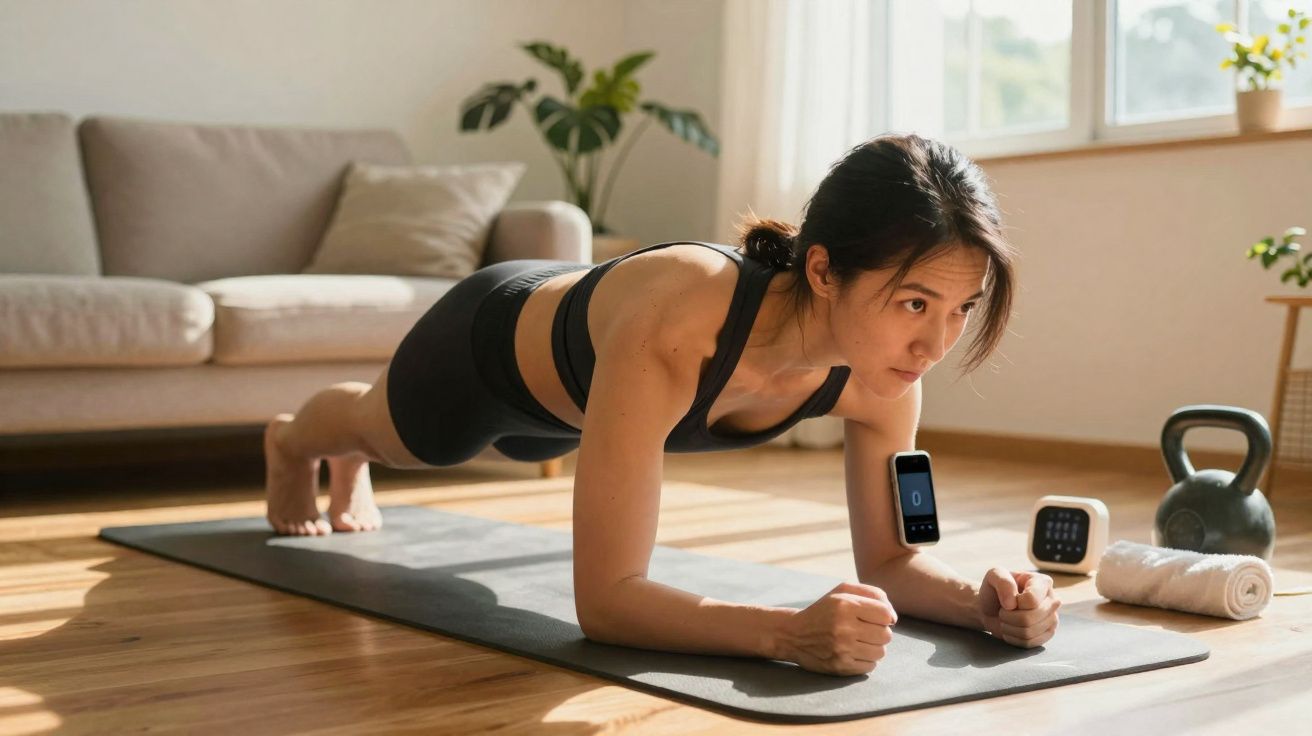
The move is the hardstyle plank, and it’s borderline cheeky in how uncomplicated it appears. You set up in a standard forearm plank-then you make every part of it intentional. Drive your feet into the ground. Clamp your glutes as though you’re gripping a winning lottery ticket back there. And pull your elbows towards your toes like the floor is a wrinkled bedsheet you’ve decided to stretch smooth.
The coach used the word “irradiation,” which is simply a posh way of saying tension travels. Claw at the ground and the message runs up your arms. Squeeze your glutes and your abs get the instruction. Done properly, your entire front line becomes a brace-not by bobbing and arching, but by refusing to shift. It’s your body being told, “This is the position, hold it, we’re safe.”
Here’s the part that stops it becoming a dull, minute-long stare at your thumbs: you don’t hang on forever. You cycle the effort. Ten seconds of full, buzzing tightness, then five seconds resting on your knees. Again and again. The timer becomes both ally and referee-and it only asks for three minutes.
Why it beats 100 sit-ups (and why your spine will thank you)
Crunches repeatedly flex the spine. That isn’t automatically terrible, but the combination of speed and volume can stack up. Plenty of us haul ourselves through the reps with help from hips and neck, so the abs get attention without really getting trained with precision. The hardstyle plank changes the job. It teaches your abs, obliques, diaphragm, lats and glutes to resist movement rather than chase it-exactly what your core is meant to do when you hoist a suitcase, sprint for the bus, or carry a sleeping child upstairs.
Another way to picture it: sit-ups can be like revving an engine while the car’s in neutral-lots of drama, a bit of smoke. The hardstyle plank is more like holding a heavy line steady when gusts hit. You learn to create stiffness on demand-anti-extension and anti-rotation, the technical labels for keeping your ribs from flaring and your pelvis from wandering. That sort of steadiness makes everything feel simpler: lifting, running, even just standing there without your lower back muttering something nasty by 4 p.m.
There’s a reason people report they “feel their core” differently afterwards. Deeper muscles wake up because you’re asking the whole system to play together, not just the flashy top layer. Three minutes of properly timed, all-in bracing leaves a clean, satisfying fatigue-without the instinct to rub your neck. It isn’t showy. It works. And it’s kind to your lumbar spine.
How to do the three-minute version, without faff
Set-up and tension you can actually feel
Begin on your forearms with elbows stacked directly beneath your shoulders; hands can be relaxed fists or palms down. Set your feet about hip-width apart, toes tucked under, and build a straight line from ears to heels. Then switch it on: squeeze your glutes hard, draw your kneecaps up to engage the quads, and picture your ribs zipping down towards your pelvis. Now try dragging your elbows back towards your toes and your toes forward towards your elbows-nothing visibly moves, but the ground suddenly feels as if it’s gripping you back.
Keep the breath low and understated, as if you’re gently misting a mirror from the inside of your belly. The cue I got was to “sip air through your nose” and send it out wide, so your stomach doesn’t jut out like a toast rack. Aim for abs that feel like a taut drum, not a wobbly tent pole. Hold that image and you’re ready for the clock.
The three-minute ladder: 10 on, 5 off, repeat
Set an interval timer for 12 rounds of 10 seconds on and 5 seconds off. Together, that’s three minutes of alternating effort and tiny breathing breaks. During each 10-second push, hit about 9/10 intensity-grip the floor, crush the glutes, lock the ribs in place. In each 5-second recovery, drop to your knees and loosen your hands. It’s brief enough to stay honest and long enough to make the lesson stick.
If this is new to you, start with eight rounds and work your way up. If you feel a back twinge, rebuild the sequence: glutes first, then ribs down, then pull against the floor. Treat the timer like a beat, not a bouncer. Those three minutes go surprisingly quickly when every 10-second window becomes its own small assignment.
If you’re already strong, the three-minute protocol still has teeth, because this isn’t a contest to see how long you can hold a saggy shape. It’s about how cleanly you can create tension and then release it on cue. That skill carries over-to deadlifts, long walks with a heavy tote, even to that awkward moment when you sneeze on a packed platform and don’t want your back to zing.
What it actually feels like (and why that shake is good)
My first attempt came with squeaky elbows, a clenched jaw, and the sensation that my stomach was being pressed flat from the inside. At second nine I was convinced the timer had frozen. By round six, a faint tremble turned up in my legs like a polite knock at the door. When it ended, there was a brilliant afterglow: warmth along my midline, no sharpness in my back, and the sense my torso had picked up a new dialect in a language lab where time runs faster than it should.
I persuaded two others there to have a go. One was a runner who’d written planks off as “boring”; the other was a new mum cautious of anything that tugged at her lower back. The runner smiled-happy that three minutes was enough to feel properly trained. The mum looked close to tears with relief when she stood up without her usual flinch. Anecdotes aren’t evidence, but that sort of relief doesn’t come from nowhere.
The shaking is a good sign. It usually means more of you is contributing, not less. It isn’t proof you’re weak; it’s your nervous system switching the lights on in rooms you haven’t visited for a while. It’s a good kind of alertness, like the hush before a great song drops.
Mistakes I made, and the simple fixes
Mistake one: letting my hips drift high or sink low, chasing the idea of a “perfectly flat” line. Fix: glutes first, then quads, then pull against the floor. That order lines up pelvis and ribs without you having to visually police yourself. If someone placed a glass of water on your sacrum it shouldn’t slide off-yet it also shouldn’t feel like a circus balance act.
Mistake two: clamping down on breath as if I were bracing for bad news. Fix: keep breaths low and quiet-two or three small nose sips during each 10 seconds, not a panicky gasp. Then, in the rest, soften your belly for a second or two before you rebuild the brace. Breathing isn’t a decorative extra here; it’s the bellows that feeds the fire.
Mistake three: turning it into an endurance slog by ignoring the rests. Fix: take the five-second kneels. The rhythm is the point. Those tiny pauses reset your brain and keep the 10-second efforts crisp. If you can chat comfortably during the work, you’re not committing enough. If you can’t blink during the rest, you’ve overdone it.
Upgrades if you want spice, not chaos
When the basic hardstyle plank feels steady, add a slow reach: during the 10-second effort, slide one arm forward a few inches without letting your hips sway, then swap arms on the next round. That anti-rotation demand lights up the obliques without turning it into a circus trick. Or inch your elbows slightly further forward to lengthen the lever, keeping the same ribs-down, locked-in position. Tiny tweaks, big payoff.
Side planks work with the hardstyle approach as well. Stack your feet, keep the elbow under the shoulder, and pull the floor apart as if your mats are sliding away from each other. Use the same 10 on, 5 off pattern, doing half the rounds on each side. The oblique burn feels purposeful, not furious.
On days you can’t face the floor, pick up a heavy bag in one hand and walk for a minute. The suitcase carry is a standing plank: it teaches your midline to stay calm while the world tries to pull you sideways. Pair it with your three-minute hardstyle session and you’ll have a core that quietly refuses chaos all week.
Make it yours at home, with real-life honesty
You don’t need a gym for this. You need a timer and a bit of carpet willing to tolerate elbows. Do it before a shower, while the kettle grumbles in the kitchen. Match it to a track that’s roughly three minutes long-and don’t stop just because the chorus finished. It becomes a small ritual: kneel, brace, breathe, shake, grin.
And honestly, hardly anyone does this every single day. Life intervenes, trains run late, someone nicks the last yoghurt. Two or three sessions a week is more than enough to notice changes: how your jeans sit, how your back behaves, how your posture quietly tidies itself up. Consistency beats intensity, and this is compact enough to repeat without dread.
The science-ish bit, in plain clothes
When you brace hard without movement, you’re teaching your body to generate stiffness that transfers force. That’s the glue between your limbs. Your lats, glutes and abs create a kind of sling that steadies the spine, and your diaphragm joins in too-which is why the breathing cues matter. This is less about sculpting a six-pack and more about building a dependable muscular corset that makes heavy tasks feel more manageable.
Sit-ups prioritise motion through the spine; the hardstyle plank prioritises control at the spine. The first can be fine in modest doses, but it often invites extra helpers-hip flexors and neck-who don’t know when to leave. The second demands teamwork and pays you back with a body that doesn’t overreact when a train door bumps your shoulder. It’s functional in the most useful, least irritating sense of the word.
Who it’s brilliant for (spoiler: not just gym people)
If you spend your day at a desk, your ribs and pelvis can end up like distant neighbours who only nod at Christmas. The plank reconnects them. If you run, it gives your stride a steadier anchor so your knees stop compensating. If you lift, it helps heavy pulls feel safer because your midline isn’t leaking strength.
It can suit people with touchy backs, provided your form stays strict and your tension stays high. The irony is pleasing: more tension, less pain. I’ve watched teachers, postal workers, new dads, and a grandmother with a sharp bob all finish three minutes of this wearing the same amazed smile. The body recognises good information quickly.
What changed for me (and what didn’t)
After six weeks of sprinkling this through my routine, my waist didn’t suddenly look like a superhero’s. That isn’t the point. What did shift was how my middle felt-firm, reliable, and less sulky by mid-afternoon when the laptop has me folded like origami. I noticed I could carry two bags of shopping without my shoulders creeping up towards my ears. I stood differently. I moved differently. It felt like upgrading the lining of a coat I already loved.
I haven’t banned sit-ups entirely. I still use them occasionally-as a movement, not a belief system. But when I want the best return for the smallest slice of time, I unroll the mat, set the timer, and look for that clean, electric ten-second groove. The beep goes, I drop to my knees, and everything narrows to an instruction I’ve come to enjoy: pull the floor.
Try it tonight, with the smallest promise
Make yourself an agreement you can’t wriggle out of: three minutes, once. No fuss, no selfies, no elaborate warm-up routine that turns into a reason to stop. Just the floor, your breathing, and that slight quake in your elbows that means your brain is learning something useful. If it clicks, keep it. If it doesn’t, at least you’ll have tested what your middle can do when it’s asked to hold rather than twist.
When the timer gives its final beep, roll on to your back and let the quiet spread out. You might catch the kettle clicking off in the next room, the neighbour’s telly through the wall, or your own breath settling like dust in a shaft of sunlight. You’ll sit up without making a thing of it-which is the neatest magic going. Three minutes, no crunches, and your core can feel as though someone’s turned the dimmer switch all the way up.

Comments
No comments yet. Be the first to comment!
Leave a Comment