
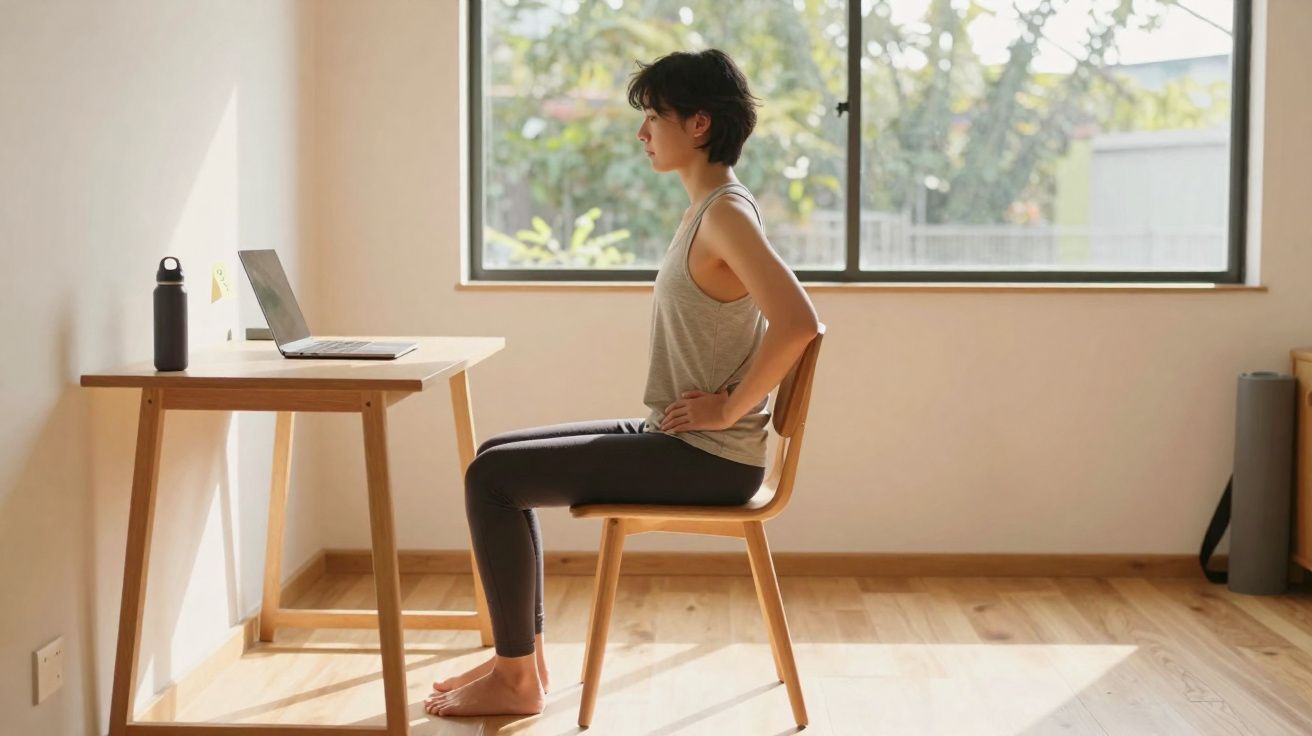
By about 5:30 p.m., your mind is still answering messages, but your body has already clocked off. Your lower back throbs with that familiar, blunt ache. Your shoulders feel as if they were replaced with concrete sometime after lunch. You push up from your chair and your joints creak like an old wooden staircase.
You shrug it off as “just being tired”. Too many emails. Too many meetings. Too many hours sitting.
Then, one day, you spot your reflection in a shop window: rounded, head jutting forwards, stomach slack, knees braced straight. Not elderly. Just… squashed.
And a quieter thought lands: is this really unavoidable?
The tiny posture habit your body begs you to learn
There’s one small adjustment hardly anyone mentions. It isn’t a workout. It isn’t a gadget. It’s simply how you stand when you’re doing nothing - and how you lower yourself into a chair.
A lot of us stand like tired flamingos: weight dumped into one hip, knees locked, belly relaxed, chest collapsed. Then, at the end of the day, we more or less drop into a chair and slide down until the backrest stops us.
It can feel like relief. Your joints don’t read it that way.
The shift is surprisingly modest: line your body up quietly when you’re standing, and when you sit, fold from your hips rather than your spine.
Take Sara, 38 - a project manager with two children and a shared calendar that’s permanently packed. She assumed her back pain was just what happens in your late thirties when you’re constantly chasing deadlines. By 4 p.m., she often had that tight knot between her shoulder blades and a low, burning ache across her lower back.
One day her physio recorded her at her desk, then again while she stopped in the corridor for a quick chat. Watching it back was grim: head forward, shoulders rounded, knees jammed straight, pelvis tipped forwards like a bucket spilling water. And every time she sat, she bent through the middle of her spine like a deck chair.
Her therapist didn’t rebuild her whole lifestyle. He simply coached her to “stand tall, soften the knees, and sit like you’re bowing, not collapsing.” Two weeks later, her end-of-day pain had fallen from a 7 to a 3 on her pain scale.
Nothing mystical happened for Sara - just better mechanics. When your ears sit above your shoulders, shoulders above hips, and hips above ankles, your skeleton does the heavy lifting instead of your muscles battling gravity for hours.
When you straighten your knees hard and shove your hips forwards, your lower back over-arches. That squeezes smaller joints and makes nearby muscles tighten. When you slump into a chair from the middle of your back, your discs and ligaments end up taking the impact.
Your body craves balance. When your weight travels cleanly down through bone, everything else can ease off. That’s why a tiny habit, repeated all day, can subtly change how your evenings feel.
The “stack and hinge” method you can use anywhere
The method is simple: “stack” when you stand; “hinge” when you sit.
Start with standing. Put your feet under your hips - not wide apart, not crossed. Imagine your weight spread across the entire foot: heel, ball, toes. Let your knees unlock so they feel springy rather than pushed backwards. Lightly draw your lower ribs in, like you’re doing up a snug pair of jeans.
Now picture a string lifting the crown of your head so your chin drifts a touch back. Your ears come over your shoulders, and your shoulders sit over your hips. This isn’t a rigid, military stance - just a quietly tall posture, as if you’ve remembered your actual height.
Then the key part: sitting down. Instead of folding through your ribs and rounding your back, shift your weight slightly towards your heels. Send your hips back as if you’re about to sit on an invisible stool. Let your torso tip forwards as one unit - head to hips - like a door moving on a hinge.
Keep your spine long: not over-arched, not collapsed. When your thighs meet the seat, lower the final few centimetres with control, still hinging at the hips. Then allow your pelvis to settle so you’re sitting on your sit bones rather than rolling back onto your tailbone.
For a few days it can feel oddly formal. Then, one afternoon, you notice your usual 6 p.m. stabbing twinge… simply doesn’t arrive.
Most people try this once, feel slightly robotic, and immediately drift back to old habits. That’s perfectly human. You’ve practised your current way of standing and sitting for years. Your body files it under “normal”, even when it’s painful.
The kinder approach is to hook the new habit onto things you already do: each time you get up from your desk, each time you queue, each time you wait for the kettle. One cue, one small correction - no fuss.
“Think of posture less like a frozen pose and more like a series of tiny, kind choices you make all day,” says a London-based osteopath I spoke with. “You’re just redistributing effort so no single part of you has to shout by 8 p.m.”
- Stop locking your knees – Softer knees let muscles absorb load, rather than dumping strain into the joints.
- Drop the one-hip lean – Standing mostly on one leg lengthens one side and squashes the other, feeding hip and lower back pain.
- Avoid chair “crashes” – Flopping down jolts your spine and rehearses the very slump your body is already battling.
- Breathe out as you sit down.
- Use doorframes, mirrors, or windows as “stack reminders” during the day.
A small daily pact with your future body
Once you start paying attention to how people stand and sit, you can’t stop noticing it. The colleague whose weight lives in their toes as their shoulders creep up towards their ears. The friend who perches on the edge of every chair, spine shaped like a comma. The way you fold when you’re worn out, as though you’re slowly surrendering your right to take up space.
This isn’t about hunting down a perfect, stiff posture. Bodies aren’t statues. They’re built to move - to shift, to slump for a moment, and then to reset. The real advantage is having a “home base”: that stacked stance and that easy hip hinge you return to, again and again, throughout the day.
And yes - no one manages it flawlessly every single day. There will be deadlines, long commutes, and evenings when the sofa wins. Still, every time you choose to stand in alignment, or sit without collapsing, you’re choosing a different kind of evening: less throbbing, less stiffness, and more of the feeling that your body is working with you.
A single small change, repeated often enough, can gently rewrite how your day finishes. Maybe that’s the comfort we’ve been missing.
| Key point | Detail | Value for the reader |
|---|---|---|
| Stacked standing posture | Ears over shoulders, shoulders over hips, hips over ankles, knees soft | Reduces muscle fatigue and joint compression throughout the day |
| Hip-hinge sitting | Shift hips back, lean forward as one unit, sit on sit bones | Protects the spine and eases end-of-day lower back and neck pain |
| Habit cues | Link the new posture to daily actions like queuing or getting up from the desk | Makes the change realistic, sustainable, and low-effort over time |
FAQ:
- Question 1: Does this replace exercise or stretching?
- Answer 1: No. Think of it as a foundation. Good posture makes your workouts and stretches more effective, and they, in turn, help you hold better posture with less effort.
- Question 2: How long before I feel less discomfort?
- Answer 2: Many people notice small changes within a few days, especially in the upper back and neck. Deeper, long-standing pain can take a few weeks of consistent practice to ease.
- Question 3: Will standing “tall” make me feel stiff or fake?
- Answer 3: At first it might. That’s just your nervous system reacting to something new. As your muscles adapt, the stacked position starts to feel more like relief than effort.
- Question 4: Can I do this if I already have back pain?
- Answer 4: Often yes, especially if your pain is linked to long sitting periods. If your pain is severe or shooting down a leg, it’s wise to talk to a doctor or physio before changing too much.
- Question 5: Does my chair or desk height still matter?
- Answer 5: Yes, your environment still plays a role. A chair that lets your feet rest on the floor and a desk at elbow height will support this new way of standing and sitting instead of fighting it.


Comments
No comments yet. Be the first to comment!
Leave a Comment