
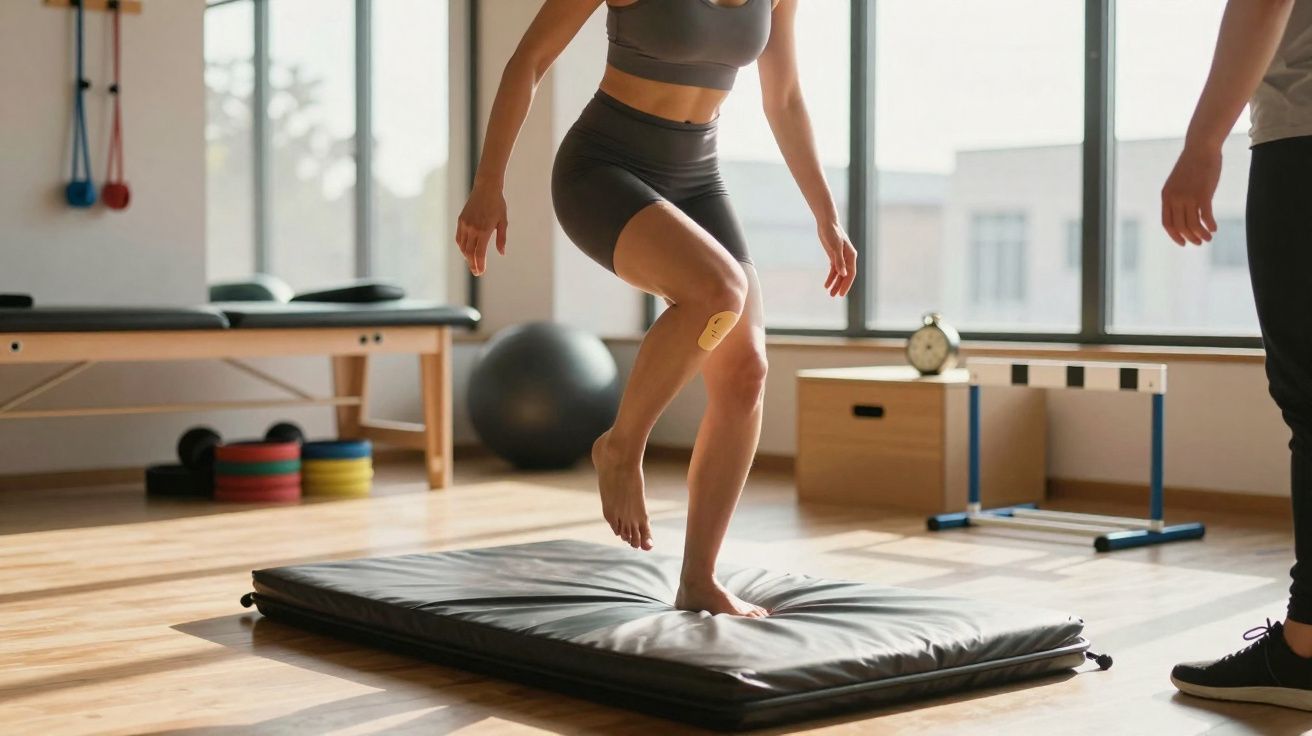
The physio room carried a faint mix of rubber matting and coffee. Anna, 46, hitched up her leggings and perched on the edge of the couch, steeling herself for the familiar checklist: “Try swimming, try Pilates, avoid impact.” Her knees had been stinging for months whenever she climbed the stairs, and she’d done everything she was told - clamshells, bridges, slow wall squats. Still, nothing shifted.
This appointment took a turn. Her therapist looked almost delighted. “We’re going to try something different,” he said, rolling over… a mini-trampoline. Anna laughed, then immediately grimaced. Jumping? On that? Her GP had been crystal clear: “No jumping, ever again.”
Ten minutes later, she stepped off the mini-trampoline sweaty and smiling - and her knees, somehow, felt freer and lighter.
The awkward bit came afterwards, when she mentioned it to her other physio.
When “no impact” isn’t the magic answer for sore knees
In clinic waiting rooms and in online threads, the advice often reads like a script: “Got knee pain? Swim. Try Pilates. Avoid jumping.” It sounds sensible, careful and low-risk. But a small (and growing) group of therapists are doing something that can look borderline irresponsible from the outside.
Instead of keeping people with sore knees away from impact, they get them upright and loading sooner - sometimes even using trampolines or gentle hopping drills before the patient feels “ready.” That one change is enough to trigger debates at conferences and spark rows inside closed Facebook physio groups.
Because if your knee hurts on the stairs, the last line you expect is: “We need to teach it to bounce again.”
Consider Mark, 52, an office worker who cycles at weekends. One spring, a short run left his right knee screaming. The judgement was immediate: “Stop running, stick to the bike, do Pilates for your core.” He followed that plan for a year.
On paper, it looked like a win. He was stronger. He moved better. Planks and bridges were no issue. Yet the moment he tried a brief jog to catch the bus, the familiar sharp pain returned beneath his kneecap. It was as if his knee had become delicate - almost allergic to everyday demands.
Then he saw a different physio, who assessed him in another way: tiny hops on the spot, brisk step-ups, and gentle pogo-style jumps on a softer surface. Eight weeks later, his knee felt more dependable than it had after twelve months of supposedly “safe” training.
This is the fault line in the profession. One side leans hard on low-impact work - swimming and traditional Pilates - with an emphasis on alignment, mobility and cautious strengthening. The other side argues a knee isn’t a fragile ornament. It behaves more like a spring.
And if you want that spring to do its job, they say you need load, speed and a touch of bounce - not reckless leaps off tall boxes, but carefully graded impact that retrains the tissues to absorb force.
The disagreement isn’t about whether gentle exercise can be useful. It centres on a more uncomfortable thought: your knee pain might not properly settle until your knee learns to tolerate impact again.
The “forbidden” activity that seems to calm angry knees
Right now, the exercise that’s splitting opinion is low-level plyometrics: small, controlled jump-and-land drills, sometimes done on a mini-trampoline and sometimes on the floor. Introduced early - not as a later-stage “extra”, but as a core piece of rehabilitation.
A session often begins with very light two-legged bouncing where you barely leave the surface. After that might come quick, soft mini-hops, side-to-side weight shifts, and simple step-and-bounce sequences. It’s brief, intentional work - a long way from Instagram “beast mode” sessions.
To most people, it looks almost silly. It also scares anyone who’s spent years hearing that impact is the knees’ worst enemy. And yet many people who persist describe the same surprising changes: less aching on stairs, more confidence on uneven ground, and a feeling that the joint is “alive” again.
Problems appear quickly when people attempt it solo. Some go too big, too early, believing they have to “push through.” Others do a few bouncy sessions for a week, get spooked by the first twinge, and stop.
The useful dose is often almost painfully gentle. Think of it like teaching the knee a new language - one quiet syllable at a time. Keep sessions short, take regular breaks, and aim to land softly, as if you’re trying not to wake a sleeping baby in the next room.
And, realistically, hardly anyone manages this daily without interruption. Work runs late. Your knees sulk after a long shift. You forget, you miss a week, you begin again. Improvements rarely come in a straight line, which is where plenty of the frustration lives.
Clinicians are just as split emotionally as the people they treat. Some see these “bouncy” sessions as a genuine breakthrough. Others recoil at asking a sore joint to absorb any shock at all. You can hear that unease in the tense, half-whispered corridor conversations at conferences.
“Impact isn’t the villain,” argues Laura James, a sports physiotherapist in London. “Chaotic impact is. When you reintroduce controlled bouncing in a safe way, the body often responds with less pain, not more. The problem is, our old education drilled ‘avoid impact’ into us for years.”
Those who favour ultra-low-impact approaches argue that any jumping can become a slippery slope, particularly for older people or those in larger bodies. Their preference is to double down on cycling, reformer Pilates and stretching.
- Gentle bouncing and mini-hops may help retrain the way the knee takes and disperses force.
- Swimming and Pilates can support recovery, but they don’t often prepare the knee for day-to-day impact.
- The split between physios commonly reflects different training eras, not simply “the science”.
- Plyometrics should be progressed slowly, with soft landings and close monitoring.
- Many patients say they feel more “stable” when impact is brought back in, rather than avoided.
So… should you really be bouncing on a sore knee?
There isn’t one neat rule for every knee. Some joints are too irritated, some operations are too recent, and some medical histories are too complex for jumping to be appropriate straight away. Any therapist selling a single perfect protocol for everyone is oversimplifying.
What this argument really reveals is something deeper: fear of movement that feels dangerous. Patients worry about re-injury, and plenty of physios worry about being the person who “pushed too hard.” That shared anxiety nudges everyone towards options that feel safest - the pool, the mat, the no-impact plan.
But everyday life contains impact in miniature. Stepping off a kerb. Sprinting for a green light. A small stumble and a quick catch. Eventually, your knees will encounter impact again.
| Key point | Detail | Value for the reader |
|---|---|---|
| Impact isn’t always harmful | Light, controlled plyometrics may reduce symptoms and build resilience when introduced progressively. | Offers another route if swimming and Pilates alone haven’t changed your pain. |
| Physios genuinely disagree | Different training backgrounds can lead to opposite guidance on jumping and knee rehabilitation. | Makes it clearer why one professional bans impact while another encourages it. |
| You can ask for “bounce” in your rehab | Ask for a graded impact plan: mini-hops, soft landings, and clear progression rules. | Helps you take an active role, rather than only doing exercises that feel overly safe. |
FAQ:
- Question 1Is jumping always bad for arthritic knees?
- Answer 1Not always. For some people with stable, mildly arthritic knees, carefully dosed low-level jumping can improve shock absorption and confidence. The key is medical clearance, soft landings, and starting well below your pain threshold.
- Question 2What if swimming and Pilates already help my pain?
- Answer 2In that case, keep them. If you want to walk faster, hike, run for a train, or play with kids, a small amount of impact work can be a sensible next stage once symptoms are settled.
- Question 3Can I try mini-trampoline exercises at home without a physio?
- Answer 3You can, but begin with extremely gentle bouncing where your feet barely leave the surface, for 30–60 seconds at a time. If pain jumps during the session or the next day, stop. If you’re unsure, arrange at least one face-to-face assessment.
- Question 4How long before I feel any benefit from plyometrics?
- Answer 4Many people notice more “lightness” or confidence within 3–6 weeks if they complete two or three short sessions per week. Physical tissue changes take longer, but the nervous system can adapt surprisingly quickly.
- Question 5Why does my physio still tell me to avoid all impact?
- Answer 5They may be taking extra care because of your medical history, or they may work from a more traditional low-impact model. You can ask directly: “When and how could we safely reintroduce small amounts of impact?” That question alone can open a more nuanced conversation.

Comments
No comments yet. Be the first to comment!
Leave a Comment