
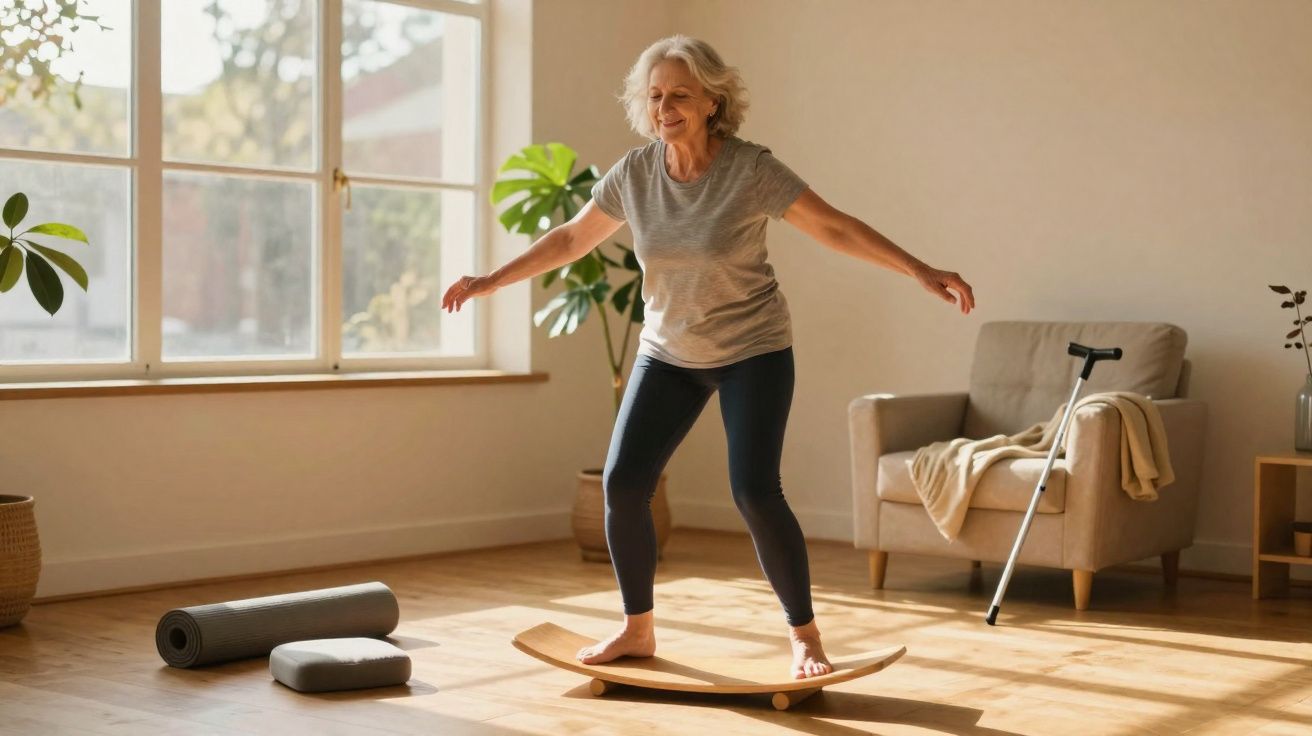
The woman in the blue windcheater is 72 - though you would never put her age at that by watching her thread her way along the painted lines in the car park. It’s still early, the air has a cool edge, and while most shoppers head straight into the supermarket, she’s doing something that looks equal parts peculiar and brilliant. She places one foot directly in front of the other, heel to toe, arms slightly raised like a tightrope walker, eyes fixed on the far end of the white stripe. She sways once, chuckles to herself, and resets.
No one applauds. No one really pays attention.
And yet this tiny routine could quietly shape whether she’s still managing the stairs on her own at 85 - or whether she’s able to catch herself during that one awkward fall.
The whole trick is tucked inside an almost childish, simple habit.
The quiet power of practicing balance after 60
Step into any waiting room filled with people over 60 and the familiar themes come up fast: blood tests, aching joints, the occasional memory slip. Coordination hardly ever gets a mention. It tends to arrive on the agenda only after someone trips on a rug or finds they can’t step off a kerb without tensing their whole body.
Balance and coordination don’t vanish overnight; they dim gradually, much like vision as the light fades at dusk. You don’t spot the first small loss. Then, one day, the world seems to tilt a fraction too quickly - and your body exposes a reality that’s been accumulating for years.
Researchers have a stark, straightforward way to check this: the single-leg stance. Stand on one leg with your arms by your sides and your eyes open, then time how long you can hold it. A large 2022 study published in the British Journal of Sports Medicine found that people in their 60s and 70s who couldn’t keep the position for 10 seconds were almost twice as likely to die over the following decade. Not from one particular cause - from all causes.
On the surface, failing to balance for 10 seconds sounds like a mild inconvenience. On paper, it’s a warning sign you can’t ignore.
The reason behind it is simple - and unforgiving. Every time you walk, climb stairs, turn around, or reach up to a high shelf, your brain runs a complicated system: vision, inner ear, joints, muscles, reflexes. As you age, both the “software” and the “hardware” underneath become less reliable.
But coordination isn’t simply lost; it can be bargained with. Even in your 70s and 80s, the nervous system remains capable of adapting - if you give it a reason to. The problem is that everyday life, particularly a seated one, rarely makes that demand.
The habit that quietly trains your coordination: deliberate balance play
The routine that makes the difference is almost comically small: intentionally practise balance every day. Not just at the gym. Not only in a class. In the gaps of your normal day.
Stand on one leg as you clean your teeth. Walk down the hallway heel to toe, like the woman tracking the car-park line. In the kitchen, pause and gently shift your weight from left foot to right, close your eyes for two seconds, then open them again.
These brief “balance breaks” turn ordinary moments into mini training sessions for your brain and body. Two minutes here, one minute there. Your body doesn’t need theatrics - it needs repetition.
A man named Carlos, 68, discovered this the hard way. After a small fall on a wet pavement, his doctor told him bluntly: “Your legs reacted too slowly.” There was no fracture - just bruised pride and a new fear of walking quickly. He began steering clear of stairs, escalators, busy crossings. His world shrank by three city blocks.
His granddaughter, a former dancer, offered him a bargain: whenever he boiled water for tea, he had to stand on one leg, touching the worktop with only two fingers. At first he managed four seconds. Then eight. After a month, he added heel-to-toe walks along the kitchen tiles. Three months later, he was on the Underground again, hand on the rail but head held high.
Beneath the kettle and the hallway lines, something very specific is going on. Balance play reactivates small stabiliser muscles in the feet, ankles, hips and spine that can spend years working on autopilot. It also pushes the brain to refresh its internal “map” of where your body sits in space.
In effect, you’re giving your nervous system safe practice at dealing with wobble. So when a real-life wobble shows up - an unexpected kerb, a slippery floor, a lively grandchild - your response is less likely to be panic and freezing. Instead, it becomes a quick adjustment, a recovery, and then you carry on. It may look daft from the outside, but inside, the wiring is being updated.
How to weave balance into your day without turning it into a chore
Begin ridiculously small - that’s the point. Each morning, when you’re at the sink, lift one foot just a few centimetres off the floor. Keep a hand hovering near the worktop; there’s no need to play the superhero. Count to five. Put the foot down. Swap sides. If five feels endless, stop at three.
Later, while you’re waiting for the microwave, place one foot right in front of the other so your heel touches your toes. Keep a slight bend in your knees, fix your gaze on one spot, and breathe out slowly. This “tightrope” stance wakes up your ankles and hips without requiring a yoga mat or sports kit.
For many people over 60, the word “exercise” instantly conjures sore knees, Lycra, and complicated YouTube routines. That mental picture can destroy motivation before you even begin. And, realistically, nobody executes an elaborate plan every single day.
The habit that sticks is the one that slots into what you already do. Link balance practice to fixed anchors: coffee brewing, television adverts, phone calls on speaker. And if you miss a day, treat it as a missed day - not a reason to quit. A wobbly 30 seconds during the news beats a perfectly designed workout that never happens.
“Balance is like a savings account,” says physical therapist Laura Kim, who works with patients in their 60s to 90s. “Every tiny practice deposit protects you from one future fall you’ll never even remember almost happened.”
- Turn stand-by time into training: brushing teeth, waiting for the kettle, lift rides.
- Always keep a “safety anchor”: a worktop, the back of a sturdy chair, or a wall within reach.
- Vary the angles: one-leg stands, heel-to-toe walking, slow side steps along a hallway.
- Keep it playful: count tiles, follow a line on the floor, balance while humming a song.
- Stop before you’re tired: the aim is consistency, not heroic effort.
Keeping your body’s “software” young, one wobble at a time
There’s something quietly affecting about watching someone in their 70s or 80s practising balance in their own kitchen. No audience. No perfect leggings. Just a person making a small wager on their future self. A few seconds on one leg, a narrow stance along the tiles, a slow turn while glancing over one shoulder.
Coordination isn’t about turning into an acrobat at 65. It’s about bending to tie your laces without grabbing the wall. It’s about crossing a busy café without that flash of fear. It’s about walking with a grandchild on your arm and knowing you’re more support than hazard. These small choices, repeated, become a kind of invisible insurance policy - one no insurer sells.
| Key point | Detail | Value for the reader |
|---|---|---|
| Daily “balance breaks” | Short one-leg stands and heel-to-toe walks tied to everyday tasks | Builds coordination without extra time or special equipment |
| Use safe anchors | Practise near worktops, walls, or sturdy chairs, progressing gradually | Reduces fear of falling and makes training feel secure |
| Think long-term protection | Better balance lowers fall risk and supports independence over decades | Offers more confident movement and a wider, freer life after 60 |
FAQ:
- How many minutes a day do I need to practice balance? Start with a total of 3–5 minutes spread across the day. A few 30–60 second bouts during daily tasks already nudge your coordination in the right direction.
- Is it safe to do balance exercises if I’ve already fallen? Yes, but begin with strong support nearby and talk with your doctor or a physical therapist. They can adapt the exercises to your level and any medical conditions.
- Do I need special shoes or equipment? No. Comfortable, flat, closed shoes and a stable surface are enough. Some people like to practice barefoot at home to wake up the feet, but always prioritize safety and stability.
- How long before I notice a difference? Many people feel a change in 3–4 weeks: less hesitation on stairs, better posture, more confidence walking. The deeper benefits, like fall prevention, build quietly over months and years.
- Can I replace walking or strength training with balance work? Balance isn’t a replacement, it’s a partner. Walking, strength training, and balance practice together give your body the best chance to stay steady, coordinated, and independent after 60.



Comments
No comments yet. Be the first to comment!
Leave a Comment