
I first clocked it on the 18:32 home, tote bag heavy with shopping, my ankles aching like they belonged to somebody twice my age.
The carriage droned along, the air carrying that familiar mix of damp coats and brake dust, and when I looked down I saw them: two neat grooves stamped into my skin where my socks had been. Most of us have had that midday moment of fiddling with laces and wondering how our tidy feet vanished before lunch. It’s not glamorous and it’s not an emergency - it’s simply… irritating. So I asked people. A hairdresser blamed the standing. A runner blamed the sitting. Then my nurse mate gave me an explanation that reframed the whole thing, starting with a tiny movement and a cushion. You can try it before you reach the end of this.
The day I met my second heart
Beth, my nurse friend, didn’t do the condescending voice. In my cramped kitchen she hitched up her trouser leg, propped her heel on a chair, and drummed two fingers on the back of her calf. “This is your second heart,” she said. “These muscles push blood and lymph back up to your chest.” The kettle clicked and I found myself thinking about how often my calves spend hours doing absolutely nothing.
My ankles weren’t rebelling; gravity was just doing what gravity does, and office chairs and long journeys had turned me into something close to a statue. When you barely move, fluid lingers in the lowest parts of you, like guests who never leave the kitchen at a party. Beth’s answer wasn’t a punishing workout, a fancy device, or an expensive sock you forget to put on. It was one small action, repeated regularly, done on purpose.
Your calves aren’t there for show - they’re a built-in pump designed to send blood back where it belongs. Once that clicked in my body (not just in my head), it was impossible to unlearn. Walking felt like it had a new brief. Even a foot tap suddenly had a point.
A small, quiet fix hiding in plain sight
The thing Beth taught me is almost annoyingly straightforward. It takes a minute - sometimes two - and the change can feel absurdly quick. It’s the flex-and-point pattern we all did as children without thinking, but with one tweak that makes it surprisingly effective. She calls it “feet up and flex”.
The first time I gave it a go, by about the tenth repetition I felt a warm surge climbing my calves, and around my ankles there was a lightness - as if a tight strap had been loosened. When I pulled my socks back up, my skin didn’t feel like it had to fight them. My day stayed the same; the difference was what my lower legs did for a tiny slice of it.
The exercise: feet up and flex
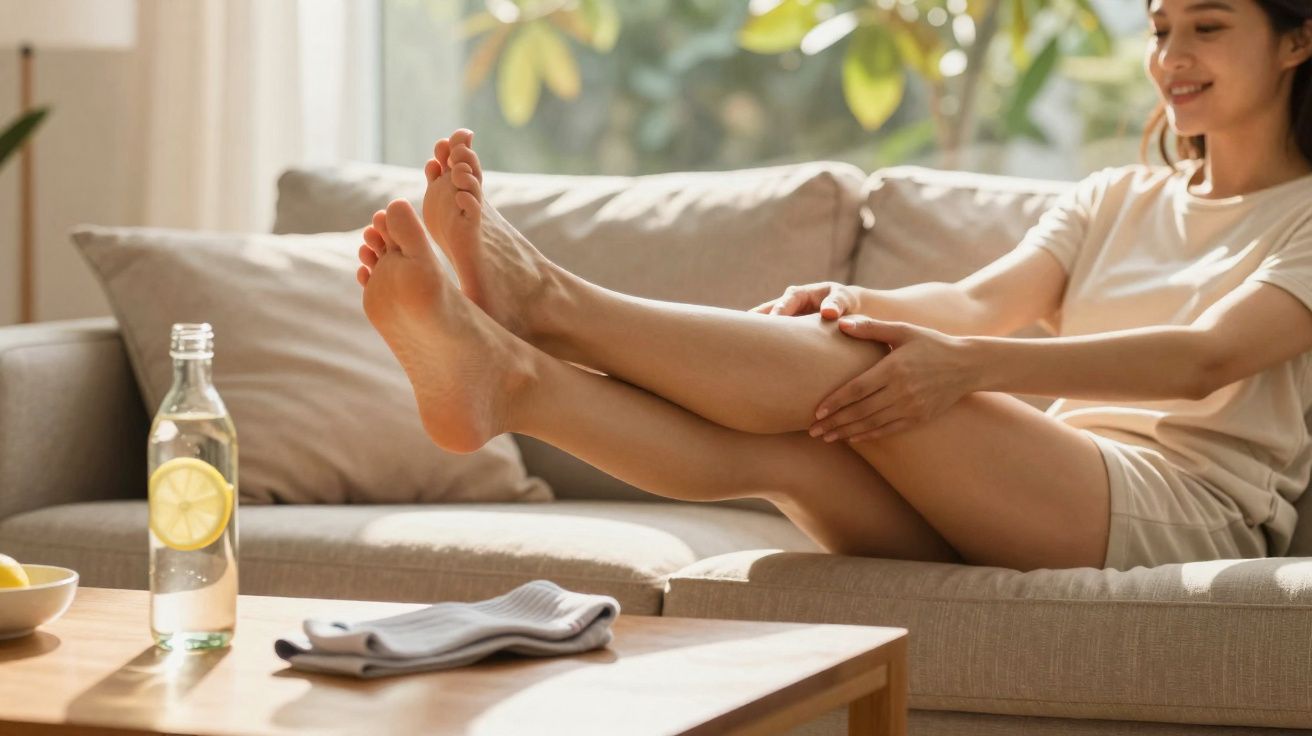
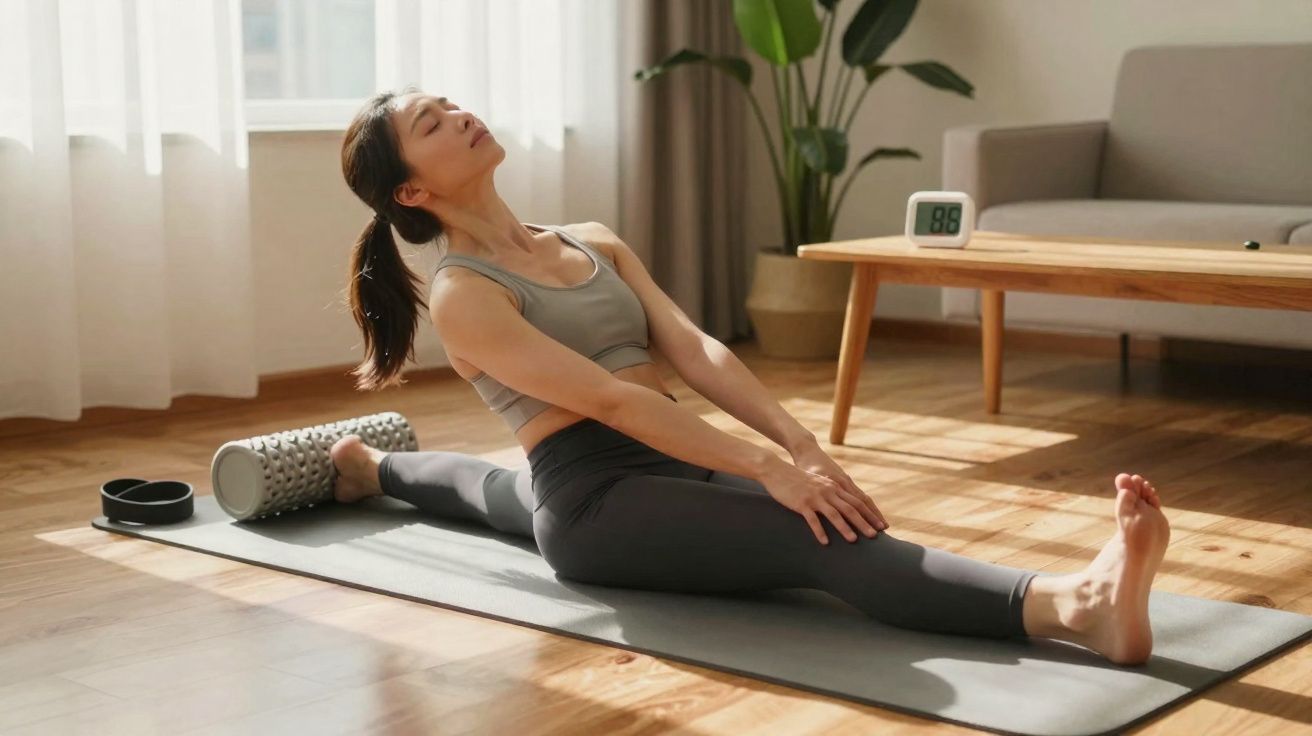
This is how Beth walked me through it, step by step. Lie on the floor or on the sofa and rest your lower legs on a stack of cushions, a pouffe, the arm of a chair - anything that raises your heels to just above heart level. If you’ve got a wall, shuffle your hips close and send your legs up it, making a relaxed L-shape. Keep your knees soft rather than locked. Let your ankles relax.
Then do the movement: flex and point. Pull your toes towards you until you feel your calves engage, then press your feet away as though you’re pushing a pedal. Make it smooth, not snappy. Breathe normally. Go for 60 to 90 seconds, pause, and repeat if it feels good.
Try it for one minute and you can almost watch your ankles shrink, as if the air’s been let out. It isn’t a trick; it’s simple mechanics plus muscle, helped along by gentle elevation. The first few times, you might notice a faint pins-and-needles murmur, or your skin looking less shiny, or the sock line easing. That’s the whole aim.
If lying down isn’t possible, there’s still a usable version. Sit on the edge of a chair with your legs slightly out in front. Rock from heel to toe like you’re balancing on invisible waves. Lift your heels while keeping your toes down, then switch. Under a desk, in a queue, on a plane - this is the one. No one needs to be aware of it except your calves and your future self.
Little cues that make it sweeter
Small details can make it feel easier. Picture your big toe drawing towards your nose so you capture the full length of the calf. As you point away, imagine your heel pressing into a soft sponge. Keep the ankle movement controlled rather than flappy; think hinge, not flutter. If your hamstrings complain, bend your knees slightly and carry on.
When I want the quickest noticeable shift, I add a little nod to the lymph side of things. After a minute of flexing, I use both hands to sweep lightly from ankle to knee, then from knee to thigh. It’s not deep massage - more like a polite reminder that fluid is allowed to travel upwards. Your skin warms under your palms, and the feeling is oddly optimistic.
Why it works: pressure, valves and that quiet whoosh
Your legs contain clever one-way valves that help blood travel upwards while discouraging it from slipping back down. Each time you walk or flex at the ankle, your calf muscles squeeze like a hand on a toothpaste tube. That squeeze creates pressure, the valves do their job, and blood moves in the direction we’d all prefer. Stay seated for ages or stand without moving, and the pressure fizzles out, the valves do less, and fluid pools in your feet and ankles.
Lifting your legs changes the maths. Gravity stops yanking so hard at your ankles. With elevation, that flex-and-point becomes a kind of lift-and-carry for circulation. The lymph system - slower-moving and fond of rhythm - often seems to respond to the repeated squeeze too. People who spend all day on their feet do a version of this instinctively: they put their legs up and fidget. This just gives it a name and a tempo.
When swelling is the problem, small movement done often tends to beat grand gestures. A five-mile run won’t undo what eight hours of sitting created if your calves never got to do their modest job in-between. Think of this as sending steady little nudges to your circulation, rather than one desperate message at midnight.
Real legs, real days
At the salon by my station, Hannah stands for hours on a mat that squeaks whenever the chair swivels. She began doing subtle heel-toe rocks between clients, and “feet up and flex” during her lunch break. “It’s like someone opens a valve,” she said, flicking her fringe back. She stopped buying the socks that promise comfort but leave you with a ridge you end up scratching at 3am. She still loves the work. Her ankles, these days, seem to love her back.
My mum tried it after a long day in the garden, coming indoors with damp-earth smell clinging to her trousers. She lay on the carpet with her calves on the sofa and flexed slowly, eyes shut, while the dog made a serious attempt to lick her toes. “Feels like fizz going up,” she murmured, adding slow ankle circles after the main set. She’s convinced she sleeps better when her legs feel lighter, and the morning dents from her slippers aren’t so dramatic.
I even did it at work, back against the office wall, feeling mildly ridiculous. The radiator ticked, someone laughed two desks away, and somewhere around the twentieth flex I felt that gentle whoosh - like a lift setting off. The tightness inside my shoes eased. Walking to the printer, it didn’t feel like I was dragging my feet; it felt like my feet were carrying me.
Make it a ritual, not a resolution
Rituals last because they piggyback on things you already do. I’ve attached “feet up and flex” to the kettle: water on, legs up, a minute of flexing, and then the mug. If I miss the kettle moment, I do it after a shower, when the bathroom mirror is steamed and the floor feels warm under my heels. Little corners of ordinary life are ideal for this.
And honestly, nobody keeps it up daily. We intend to, then we don’t. That’s not failure; it’s just being human. Even three times a week is enough to notice a difference. Any time you spot that faint ladder pattern from your sock pressed into your ankle, treat it as your cue. You don’t need 30 minutes - you need 60 seconds when it crosses your mind.
If you sit a lot
Desk life nudges you into statue behaviour. Use a discreet hourly timer or hook it to natural pauses: email sent, call finished, kettle on. Do heel-toe rocks under your desk until you feel your calves warm, then stand up if you can and circle your ankles. When you’re home, give yourself one proper “feet up and flex”. The mark from your jeans above your sock will disappear quicker than your inbox can fill back up.
If you stand all day
Queue marshals, baristas, teachers - you know the ache that appears behind the knees right before you get a break. Work the move in by making tiny foot-waves while you chat or watch a till screen. The rocking is subtle and calming. Once you’re clocked off, do the elevated version while dinner finishes in the oven. The timer’s hiss makes a surprisingly decent beat.
Travel, heat, and life’s curveballs
On planes, trains, and that never-ending coach ride home from a match, this is a proper lifeline. Slide your heels slightly forward under the seat and go flex-point, flex-point - slow and steady - roughly every half hour. If you’re feeling bold, stand near the loos and do a few calf raises, letting your heels touch down each time. In hot weather, do the legs-up version near a fan or open window. A cold flannel on your ankles after a set feels like a tiny holiday.
If you’re pregnant or dealing with hormonal bloat, it’s a helpful option that doesn’t require an appointment. It sits comfortably alongside compression socks and the usual advice to drink water and take short walks. If swelling is brand new, only in one leg, hot or tender, or paired with chest pain or breathlessness, that isn’t a “wait and see.” Ring your GP or 111. If it’s severe, call 999. Your legs send messages; sometimes they’re saying rest, sometimes move, and sometimes get checked.
Little extras that help the cause
I’m not going to pretend one exercise replaces all the dull basics. Footwear that doesn’t bite at your ankles matters. Salty days show up in your socks. Water helps your blood travel more easily. And adding a bit of movement during phone calls beats scrolling with your feet tucked under you like a cat.
There’s also something quietly satisfying about turning this into a small act of care. I keep a cheap tube of peppermint foot cream by the sofa. After the flexing, I do the light sweeps from ankle to knee, then give the arches a bit of attention. The scent feels faintly like a spa, the result is practical, and the whole routine takes less time than a proper moan about my day.
What surprised me most
The biggest surprise wasn’t just how quickly it can change things - though that still makes me a bit giddy. It was the sense of agency. So much of the body can feel like guesswork, genetics, or “well, this is me now”. This is one of those rare, immediate, turn-the-dial moments where you can feel your body answer back in real time. It makes you trust your legs again.
And there’s a knock-on effect when your ankles stop throbbing on the sofa. You stand up after a programme without the little grunt. You take the stairs because your shoes don’t feel like buckets. You walk one stop further because your calves are awake. It’s subtle, but it’s real - like good news that doesn’t need to shout.
Try it tonight
When you get in, before you rush into dinner or scroll your way out of the day, give yourself the minute. Legs up, flex and point, breathe. Feel the warmth climb. Watch the skin soften. If you want proof, check what your socks do afterwards. Then walk to the sink and see if your feet don’t feel lighter.
This isn’t a cure-all. It’s an old, clever movement brought back into use. It works alongside walking, compression, better shoes, and less time stranded at a desk. It’s also small enough that you actually do it - the sort of habit that shifts a day, then a week, then how you think about your body carrying you around this city of stairs, rain, and late trains.
I still get the sock ring sometimes. I still forget plenty of days. But I keep a cushion near the sofa and a promise near the kettle, and most evenings the ritual wins. Lying there, toes moving like fish in a shallow stream, I imagine those tiny valves opening and shutting, blood heading home, legs releasing their grip - and a version of me who stands up light enough to dance while the pasta bubbles.
Once you’ve felt your calves doing that quiet “second heart” work, it’s difficult not to listen for it again the next day.
Comments
No comments yet. Be the first to comment!
Leave a Comment