
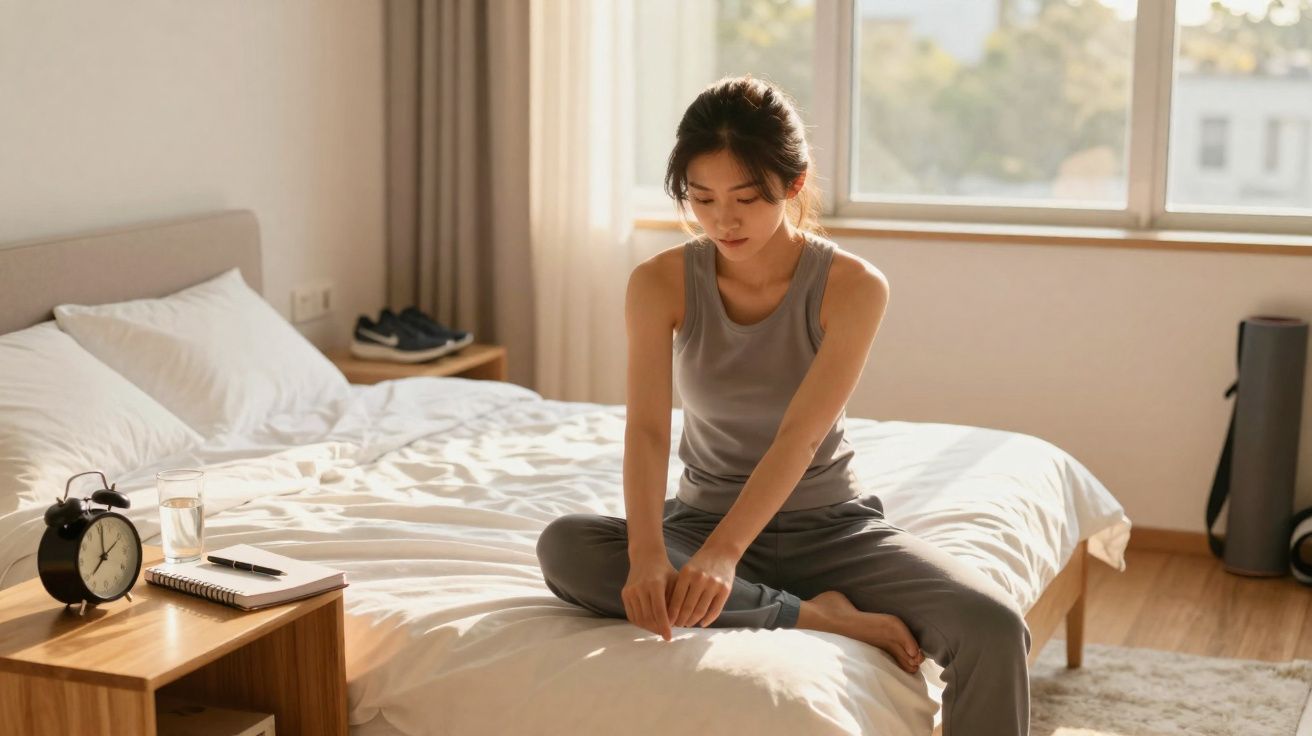
You’re lying there - half-dreaming, half-trapped in an Instagram scroll - and somewhere between fitness influencers, biohacking tips and self-improvement reels you hear the same line again: “If you really want something, you have to get up earlier.” It sounds powerful. It feels pretty flimsy when your eyes are already closing while you brush your teeth. On the way to work you notice it: your body is moving, but your mind is dragging behind. Everything feels slightly muted, a bit greyer than it needs to be. And still you tell yourself, “Tonight I’ll go to bed earlier.” Be honest: how often has that promise actually stuck?
Sleep isn’t laziness - it’s your invisible training camp
In our culture, sleeping “a lot” can make you look suspicious - lazy, unmotivated, not hungry enough. We live in a world where overtime is shown off like a trophy, while a midday nap happens in secret on the sofa, accompanied by guilt. Yet it’s in those dark hours that the toughest work is happening: repairs, fine-tuning, rewiring. While you lie still, your body operates like a crew of high-performance technicians. Your immune system filters out threats, muscles are rebuilt, and your brain clears out the day’s mental clutter. Doing nothing is, in reality, heavy labour for your system.
The blunt truth is this: your body doesn’t grow, learn and recover in the gym, in front of a laptop, or in a meeting. It does it between duvet and mattress. During deep sleep, growth hormone is released, muscle fibres are restored, and tiny micro-injuries in tendons get a kind of overnight “service”. In REM sleep, your brain organises memories, builds new connections and discards what you don’t need. Without those phases, you’re like someone training every day in a gym that’s never cleaned: plenty of sweat, little progress, and chaos everywhere. Sleep isn’t the enemy of your goals - it’s the invisible personal trainer you’ve wanted for years without calling it that.
Picture an ambitious amateur athlete - let’s call him Marco. Office job, two children, and CrossFit every evening because he wants to “get a bit more out of himself”. On Instagram he posts sweaty selfies with “No excuses” and “Never not training”. What you don’t see: Marco averages 5.5 hours of sleep. After a few months he’s constantly fighting off colds, snappy, and he starts getting mild heart palpitations. The doctor asks about stress first, then about sleep. When Marco finally manages, for the first time in years, to get 8 hours a night for a full week, something uncomfortable happens: he realises just how exhausted he actually is. And then, slowly, he feels his strength return - in training, in his head, and in the patience he has with his children.
How to programme sleep as your strongest training
If you truly treat sleep like training, it needs a fixed place in your day. Not a “we’ll see how tonight goes”, but a clear start time. You already understand training plans - so build a sleep plan: 7.5 to 8.5 hours as the default, not the exception. For one week, go to bed at the same time every day, including weekends. It sounds boring, but after two or three days it feels different. Your body thrives on rhythm. It rewards you with steadier energy, a calmer pulse and a clearer mind. Think of your bedroom as a training space: dark, cool, tidy - not an office, not an inbox, not a room lit up by screens.
We all know the moment: you’re in bed, lights out, and your brain suddenly schedules an emergency conference on “Everything that’s gone wrong in the last ten years.” Many people give up right there, grab their phone again, and escape into scrolling. That’s exactly where your hidden training camp goes under. Let’s be realistic: hardly anyone meditates for ten minutes every night, drinks only herbal tea and reads a philosophical book. But a small, doable blend of evening rituals does work: dim the lights an hour before bed, have a glass of water, maybe take three deep breaths by an open window. Nothing heroic - just a quiet signal to your body: “Training starts now, softly.”
A sleep coach once put it like this:
“You have to take your sleep as seriously as your biggest project. Because without it, every other project quietly fails in the background.”
If you want to live sleep as training, a few small levers can trigger surprisingly big changes:
- A fixed “offline” moment: no phone, no emails, no social media for 30 to 60 minutes before bed.
- A consistent sleep window: aim for the same time each night, plus/minus 30 minutes.
- A quick morning check-in: how did you wake up? Energy from 1 to 10? No app - just you and your sense of it.
- A clear “no” to caffeine four to six hours before going to sleep.
- A deliberate “yes” to darkness: shutters, curtains, maybe a sleep mask - so your brain properly understands it’s recovery time.
When you sleep well, you’re training even when you do nothing
The most surprising idea might be this: sleep isn’t the opposite of performance - it’s the condition for it. Strong nights don’t just make you less tired; they make you sharper, quicker and more patient. Studies suggest that people who regularly get enough sleep make better decisions, eat more balanced meals and get injured less often in sport. Anyone who’s tried to have a serious conversation after only four hours’ sleep knows how fragile self-control becomes without recovery. Suddenly everything feels personal, every small comment lands like an attack. A well-rested body can take more before it flips into alarm mode.
It gets even more interesting once you realise that sleep also trains you psychologically. Emotions are “filed away” at night, small daily mini-traumas are softened, and positive experiences are anchored more firmly. Children who sleep badly are often inconsolable the next day, on the verge of tears. Adults just hide it better. If you keep sacrificing your nights, you unknowingly train yourself into having thinner skin. And that’s the core of it: sleep is the training that makes you stronger for all the other training - physically, mentally, emotionally. Perhaps the most radical productivity strategy of our time isn’t a new hack or yet another app, but the honest sentence: “Tonight I really am going to bed earlier.”
| Key point | Detail | Added value for the reader |
|---|---|---|
| Sleep as an active training process | In deep and REM sleep, muscles are repaired, hormones are regulated and memories are sorted. | Understands why real performance and progress eventually break down without enough sleep. |
| Rhythm instead of chance | Fixed bedtimes, a dark room and reduced blue light act like a training plan for the body. | Can build concrete routines that visibly improve energy and recovery in everyday life. |
| Emotional resilience through sleep | Well-slept nights strengthen decision-making, stress resistance and emotional stability. | Experiences how sleep lifts mood, defuses conflict and eases relationships. |
FAQ:
- How many hours of sleep do I actually need? Most adults fall within 7 to 9 hours. If you wake without an alarm and rarely feel sleepy during the day, you’re likely in your personal ideal range.
- Does it matter when I sleep? Yes - your body follows an internal rhythm. Sleep before midnight isn’t “magic”, but consistently falling asleep before 23:00 fits well with many people’s natural pattern.
- Can I catch up on sleep at the weekend? You can offset short-term deficits a little, but long-term sleep deprivation can’t be fully “caught up”. A steady rhythm is more powerful than extreme lie-ins.
- What if I just can’t fall asleep? Get up again after 20–30 minutes, go to another room, read something calm, and only return to bed when you feel sleepy again. Your bed should be associated with sleep, not lying awake.
- Is a midday nap helpful, or does it harm night-time sleep? A short power nap of 10–20 minutes in the early afternoon can help and usually won’t disrupt night-time sleep. Long naps late in the afternoon often make it harder to fall asleep.


Comments
No comments yet. Be the first to comment!
Leave a Comment