
The gym was nearly deserted, with only the far-off rattle of plates and the steady drone of treadmills filling the space.
By the mirrored wall, a man in a vivid red top bobbed into a hamstring stretch, teeth set, trying to force out one more inch. Beside him, an older woman eased down towards her toes as though time didn’t matter, settling into the position like a long, unhurried breath.
He winced. She exhaled.
A few minutes later, he was kneading his lower back. She rose a little taller, circled her shoulders, and drifted off looking lighter-almost as if she’d just come from a massage.
Same aim, completely different approaches. One tried to overpower his body. The other allowed hers to respond.
And your muscles can tell which strategy feels safe.
Why slow stretching wins over brute force
If you watch someone who claims they “hate stretching”, the pattern is usually obvious: they sprint through it. A rapid toe touch, a rushed quad pull, a twist that resembles a grappling move more than mobility work. Your body interprets that speed as danger, not help.
Slow stretching communicates the reverse. When you glide into a position, your nervous system gets a chance to assess what’s happening and relax its guard. The muscle isn’t yanked into place; it’s coaxed there. Breathing becomes steadier, tension eases, and-bit by bit-your usable range expands.
That’s the understated point: flexibility is influenced less by “stretchy” muscles and more by how secure your brain feels as you move.
Think about runners lining up before a Sunday 10K. There’s always a group doing quick, springy lunges, bouncing in and out as if they’re racing the clock. It looks lively, even impressive. Five kilometres later, plenty of them are tugging at tight calves or complaining about hips that have seized up.
And then there’s the person off to one side, headphones on, treating each stretch like a calm exchange. Thirty seconds. Breathe. Ease a fraction deeper. No theatrics, no strain-just a slow back-and-forth between brain and body. Statistically, that second approach tends to mean fewer niggles and better progress over time.
Sports physios witness this week in, week out. The people who “really go for it” often stall for months. Those who move gradually, hold within comfort, and repeat the habit consistently can gain extra centimetres of reach without the same level of soreness or strain. Pushing hard can feel like effort-yet it often works against you.
There’s a straightforward explanation. Your muscles come with built-in warning systems: tiny sensors (in the tendons) that react when a stretch arrives too fast or too far. Their response is to tighten up to protect you-a protective reaction called the stretch reflex. Aggressive stretching triggers that alarm repeatedly.
Slow stretching, by contrast, is like lowering the volume. When you enter a position progressively, those sensors have time to settle. Your brain revises its internal “safe range” map. Instead of resisting, the muscle releases a little more. You’re not only lengthening tissue; you’re training your nervous system.
That’s why wrenching your hamstring for ten seconds won’t suddenly make you supple-it simply teaches your body that stretching is something it needs to brace against.
How to stretch slowly so your body actually changes
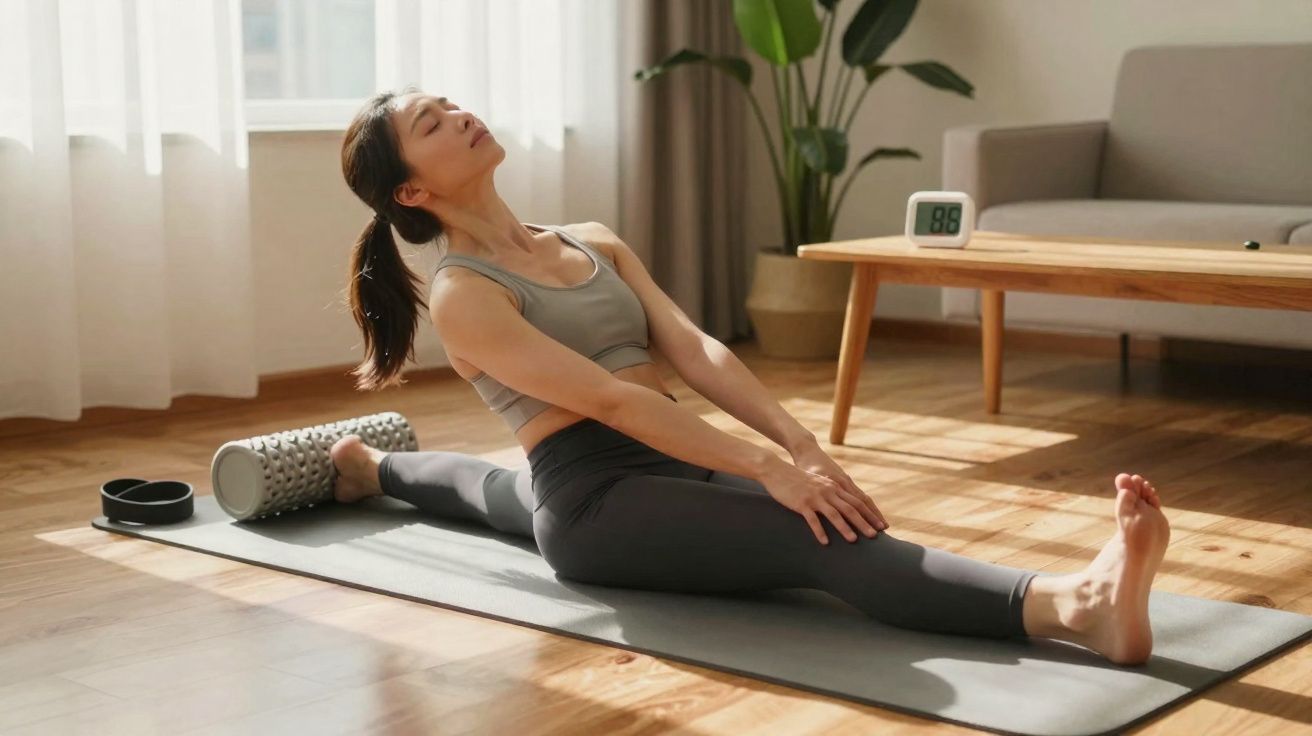
Treat each stretch like a dimmer switch rather than a light switch. Move into the shape until you notice the first definite pull-not the “I’m about to tear” sensation. Pause there. Inhale through your nose, then take a long breath out. Hold for 20 to 40 seconds, allowing the intensity to drop slightly.
On your second or third exhale, ease a tiny amount further. No bouncing. No muscling through. Just a controlled, gentle slide into a little more range. You’re aiming for mild, manageable discomfort-not brave, headline-making pain. When you stay in that tolerable zone, the nervous system slowly stops sounding the alarm, and the muscle softens.
Three or four stretches done this way, a few times a week, will beat a single violent “I’ll sort my hips out today” session every time.
This slower approach works best as a simple routine, not a 45‑minute endurance test. Choose three areas that genuinely limit your day-to-day life: perhaps hamstrings so you can tie your shoes without groaning, hip flexors tightened by hours of sitting, and an upper back that keeps your neck grumbling.
Spend roughly a minute on each area, then repeat the circuit once more. Done. Ten intentional minutes can change how your body feels far more than a once-a-month stretching binge. The difficult part is not speeding up, because stretching rarely feels like “proper” work.
In practical terms, attach it to something you already do. After your run. Before your evening shower. While the kettle boils. On a mat beside the sofa as the credits roll. Let’s be honest: hardly anyone keeps it up every day. But three calm sessions per week? That’s achievable-and for most people, enough to make a noticeable difference.
Quick, forceful stretching often starts with good intentions: frustration. You feel stiff, so you push harder. You watch someone fold effortlessly into a forward bend, and your ego joins in. That’s where trouble starts-micro-tears, pulled muscles, and a brain that quietly labels stretching as “risky”.
Going slowly is a form of respect. Respect for your tissues, and for where you are today-not where you were ten years ago. After a week of poor sleep, everything may feel tighter and tougher. On a relaxed Sunday, you might sink a little further. Both are normal.
“Flexibility isn’t about forcing your body into shapes; it’s about teaching your body that those shapes are safe.”
Keep yourself on track with a few simple guardrails:
- No sharp, stabbing, or electric pain-ease off immediately.
- Breathe smoothly; if you’re holding your breath, you’ve gone too far.
- Stretch when you’re warm, not straight out of bed or after sitting still for hours.
- Improve in millimetres, not with ego-led leaps.
Those small choices are what turn stretching from a task you avoid into a quiet routine your body begins to welcome.
Letting your body set the pace – and winning long term
Slow stretching clashes with how many of us treat our bodies. We prefer fast fixes, visible struggle, and sweat that proves we’ve “earned it”. Flexibility doesn’t operate like that. It improves quietly, at the pace of trust.
The people who do best with mobility aren’t necessarily the strongest or the most relentless. They’re the ones willing to pay attention: noticing their shoulders drop after a long exhale, realising they can sit cross‑legged on the floor without pins and needles. Small wins, but they stack up.
At a deeper level, slow stretching can be an unexpectedly honest mirror. Hold a stretch for 30 seconds and your mind tends to wander in: impatience, self-criticism, comparison. You get a close-up view of how you respond to discomfort. Learn to soften there and it doesn’t stay on the mat-it carries into long meetings, difficult conversations, packed trains.
One quiet stretch at the end of the day can become a small refusal to live at the world’s constant pace. You choose slower, gentler, smarter.
| Key point | Detail | Why it matters to you |
|---|---|---|
| Slowness calms the nervous system | Gradual movement reduces the muscle’s protective reflex | Improve flexibility without pain or a “stuck” feeling |
| Less force, more consistency | Short, frequent sessions outperform occasional aggressive efforts | Fit stretching into a busy life more easily |
| Safety before performance | Respect pain signals, breathe, and progress millimetre by millimetre | Reduce injuries and keep your progress over time |
FAQ:
- Should I stretch before or after a workout? Slow, static stretches tend to work best after exercise, when your muscles are warm. Before training, it’s usually better to choose controlled dynamic movements to prepare the body without making it feel “too loose”.
- How long should I hold each stretch? Aim for 20 to 40 seconds for most positions while breathing deeply. Two to three repetitions per muscle is enough for most people.
- Is bouncing during stretching really that bad? Fast bouncing strongly triggers the muscle’s protective reflex and can lead to small injuries. For lasting mobility gains, slower, controlled movement is the better option.
- Can I get flexible if I start as an adult? Yes. Even after 30, 40, or 50, the body can adapt. You may not end up doing the splits, but you can significantly improve everyday comfort and range of motion.
- How many times a week should I stretch to see results? Three calm sessions per week is often enough to feel a real change after a few weeks. The key is not duration, but consistency and gentleness.



Comments
No comments yet. Be the first to comment!
Leave a Comment